 EN
 BR
 DE
 ES
 FR
 RU
 ID
 TR
 IT
 JP
 SA
 VN
 TH
 KR

VPN Concentrators Explained: What They Are and How They Work

 Key takeaways

- VPN concentrators aggregate and manage large numbers of incoming VPN tunnels — from remote employees or branch offices — into one organization's network.
- They come in two main forms: dedicated hardware appliances and virtual (software-based) concentrators running on standard servers or cloud instances.
- AWS Site-to-Site VPN Concentrators handle the same aggregation problem as a managed cloud service, built around Transit Gateway rather than physical boxes.
- Concentrators typically make sense once an organization is managing 100+ simultaneous remote connections or 25+ site-to-site tunnels — well beyond what most small businesses or individuals ever need.
- A personal VPN like Guru VPN solves a different problem entirely: protecting one person's own outbound traffic, not centralizing an organization's inbound connections.
If you've spent any time researching enterprise networking, you've probably run into the term "VPN concentrator" and wondered whether it's just a fancier name for the same technology powering personal VPN apps. It isn't, exactly. A personal VPN app like Guru VPN protects the traffic leaving one device; VPN concentrators are purpose-built hardware or software designed to aggregate and manage dozens, hundreds, or even thousands of encrypted tunnels flowing into a single organization's network at once. Understanding what vpn concentrators actually do — how they're built, and where the line sits between enterprise infrastructure and personal privacy tools — makes it much easier to figure out which category actually applies to your situation.
This article breaks down how these devices work, the difference between hardware and virtual deployments, how AWS handles the same problem in the cloud, and why the vast majority of individuals and small teams are better served by a straightforward personal VPN than by anything resembling enterprise concentrator infrastructure.
Key Takeaways
- VPN concentrators aggregate and manage large numbers of incoming VPN tunnels — from remote employees or branch offices — into one organization's network.
- They come in two main forms: dedicated hardware appliances and virtual (software-based) concentrators running on standard servers or cloud instances.
- AWS Site-to-Site VPN Concentrators handle the same aggregation problem as a managed cloud service, built around Transit Gateway rather than physical boxes.
- Concentrators typically make sense once an organization is managing 100+ simultaneous remote connections or 25+ site-to-site tunnels — well beyond what most small businesses or individuals ever need.
- A personal VPN like Guru VPN solves a different problem entirely: protecting one person's own outbound traffic, not centralizing an organization's inbound connections.
So, What Are VPN Concentrators, Exactly?
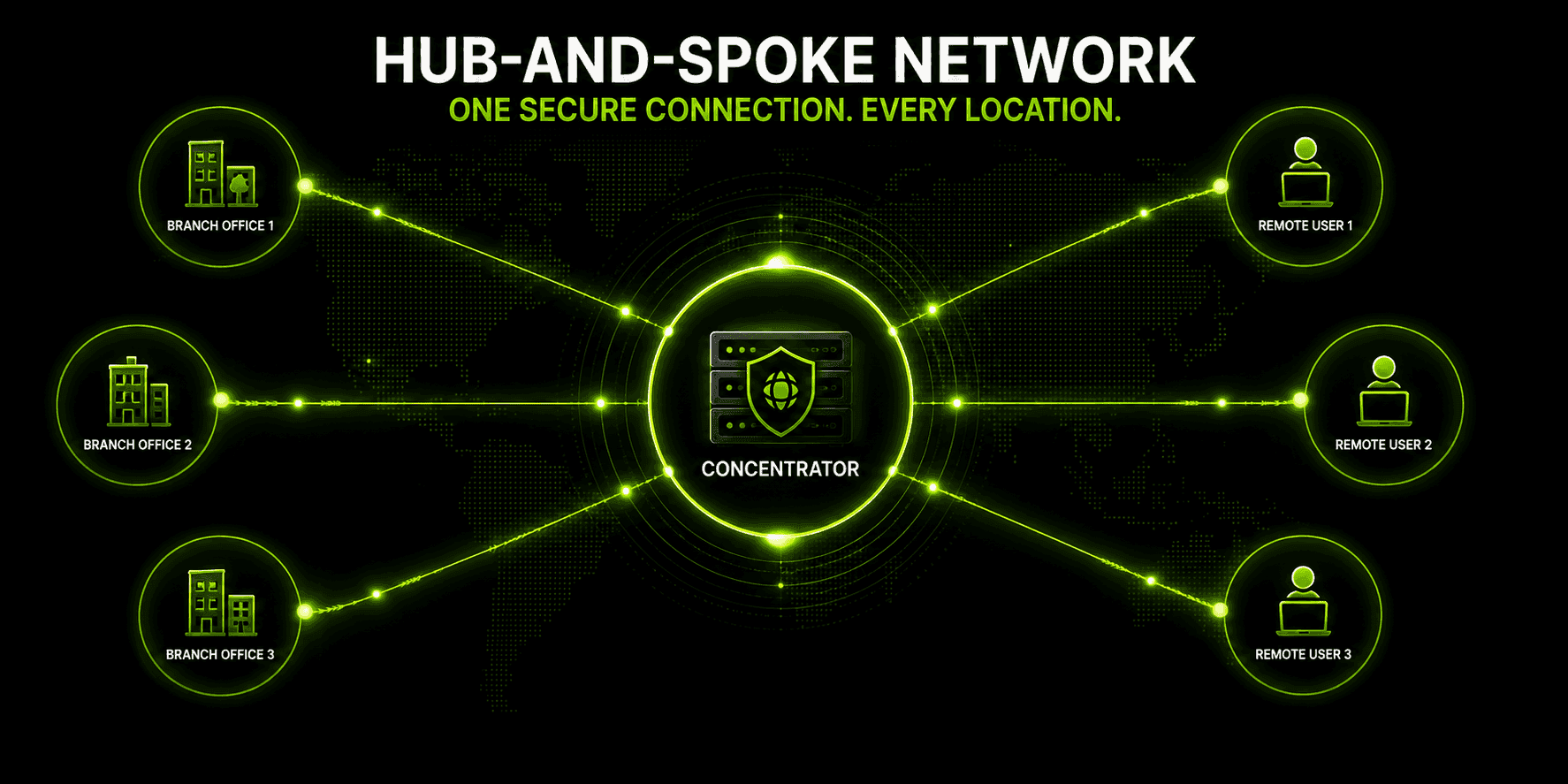
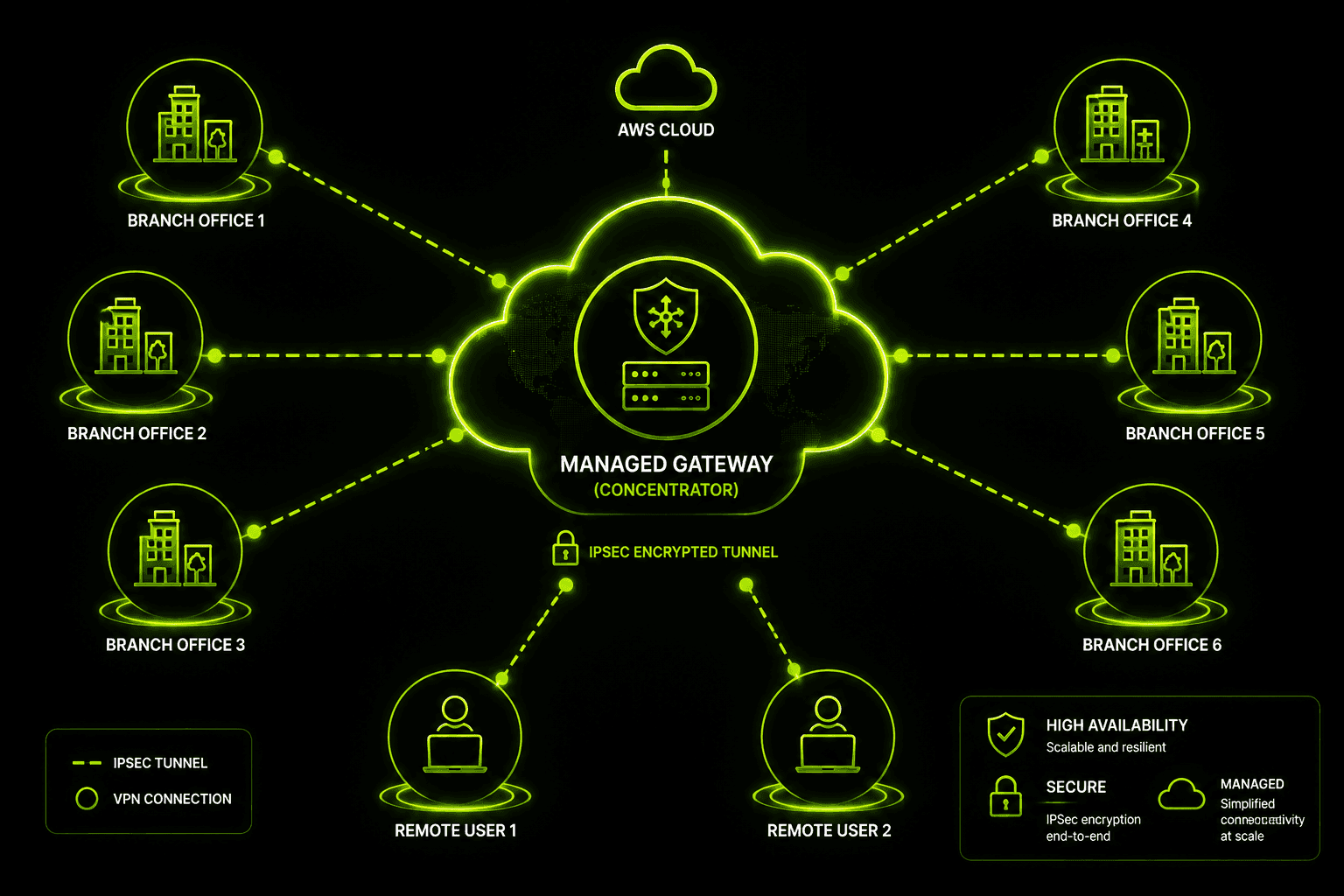
At its core, a VPN concentrator is a device — or a piece of software performing the same role — that sits at the edge of a network and terminates a large number of VPN connections in one place. Instead of a company configuring dozens of individual firewalls to each handle a handful of tunnels, all of that traffic gets funneled into one concentrator that authenticates every connection, encrypts and decrypts the traffic passing through it, and routes it to the right destination inside the internal network.
The term shows up most often in the context of remote-access VPNs (connecting individual employees back to a corporate network) and site-to-site VPNs (permanently linking two or more office locations, data centers, or cloud environments together). In both cases, the concentrator's job is the same: be the single, well-managed point where all of that encrypted traffic converges, rather than leaving tunnel management scattered across the network.
How Do VPN Concentrators Work?
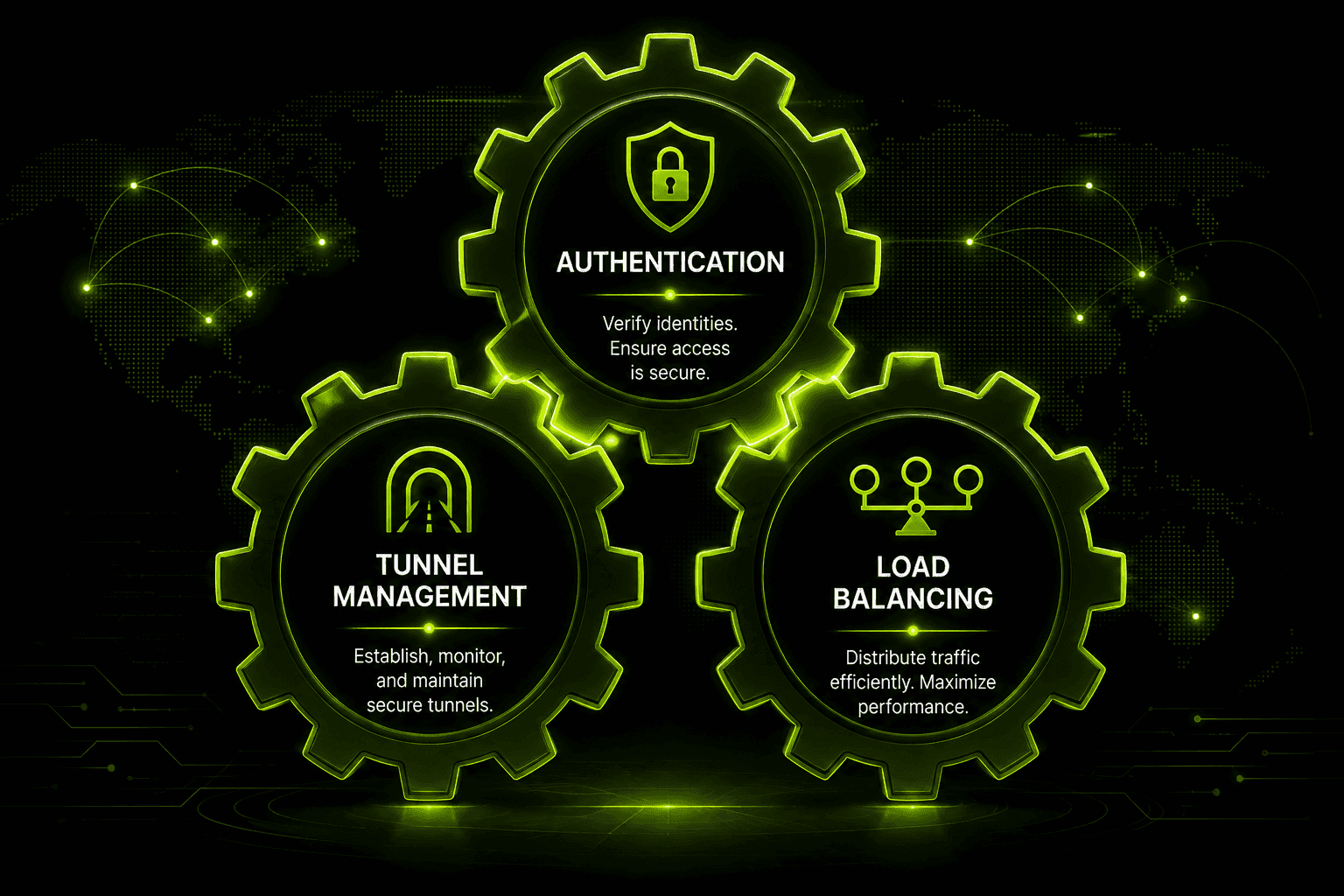
Three things happen, more or less continuously, inside a working concentrator.
Authentication comes first. Before a tunnel is allowed to form, the concentrator verifies the identity of whoever — or whatever — is trying to connect, typically against a centralized directory service, a certificate authority, or a RADIUS server. This is what stops an attacker from simply pointing a VPN client at the concentrator's public IP address and getting in.
Tunnel management is the ongoing work of maintaining every one of those active connections: negotiating encryption parameters when a tunnel first comes up, re-keying periodically for security, monitoring for tunnels that have gone silent, and tearing down sessions that end normally or time out. On a concentrator handling hundreds of simultaneous connections, this bookkeeping is constant.
Load balancing becomes necessary once traffic volume grows past what a single processing unit can comfortably handle. Enterprise concentrators — and clusters of virtual ones — distribute incoming tunnels and their traffic across multiple processing paths so no single point becomes a bottleneck, and so a hardware failure in one unit doesn't take every connection down with it.
Hardware vs. Virtual VPN Concentrators
Concentrators aren't limited to one form factor. Organizations choose between dedicated physical appliances and virtual VPN concentrators depending on scale, budget, and how much of their infrastructure already lives in the cloud.
| Feature | Hardware Concentrator | Virtual VPN Concentrator |
|---|---|---|
Form | Dedicated physical appliance | Software running on a VM or cloud instance |
Performance | Predictable, purpose-built processing | Scales with underlying compute resources |
Scaling | Requires buying additional units | Often scales by adding compute or instances |
Deployment location | On-premises, in a data center | Cloud, virtualized data center, or hybrid |
Typical use case | Large enterprises with steady, high tunnel volume | Cloud-native organizations, variable workloads |
Hardware options — appliances from vendors like Mako Networks' 7000 and 8000 series are a common example — are built for consistent, high-throughput performance and tend to be the choice when an organization already has significant on-premises infrastructure and wants predictable capacity. Mako's rackmount models, for instance, are commonly cited around 850 Mbps of VPN throughput, giving a concrete sense of what dedicated hardware delivers out of the box. Virtual VPN concentrators, by contrast, run as software — sometimes on general-purpose servers, sometimes on specialized platforms like 6WIND's virtual router software, which is built specifically to push VPN throughput on standard hardware closer to what dedicated appliances achieve — 6WIND has cited figures as high as roughly 18 Gbps per CPU core in optimized deployments, illustrating just how far software-based concentrators have closed the gap with purpose-built hardware. The appeal is flexibility: spin up more capacity when tunnel volume grows, without waiting on a hardware order.
Major VPN Concentrator Vendors and Protocol Types
Beyond Mako and 6WIND, most enterprise networks run concentrator functionality through a handful of familiar names: Cisco (both dedicated ASA appliances and Meraki's cloud-managed line), Fortinet's FortiGate series, Palo Alto Networks' GlobalProtect, Check Point's gateway appliances, and Aruba's remote-access hardware. Rather than being sold as a single-purpose "concentrator" box, this functionality is often bundled into a broader firewall or security appliance, with concentrator-style tunnel aggregation as one of several features running on the same hardware.
These vendors also split along a protocol line worth understanding: IPsec concentrators handle traditional site-to-site and client VPN tunnels at the network layer, typically favored for connecting whole office networks together. SSL VPN concentrators instead terminate connections at the application layer, often through a browser or lightweight client, and tend to be the choice for remote-access scenarios where a full network-level tunnel is more than what's needed — a contractor who only needs access to one internal web app, for example. Many modern appliances support both modes simultaneously, letting an organization mix site-to-site IPsec tunnels with SSL VPN remote access on the same box.
Cost scales sharply with capacity. Entry-level concentrator appliances suited to a small office can start around $200, mid-tier hardware built for a few hundred simultaneous tunnels commonly runs $800 to $1,500, and high-capacity enterprise deployments supporting thousands of tunnels can run into the thousands of dollars before licensing and support contracts are even factored in — a cost structure that has little in common with a consumer VPN subscription.
AWS Site-to-Site VPN Concentrators
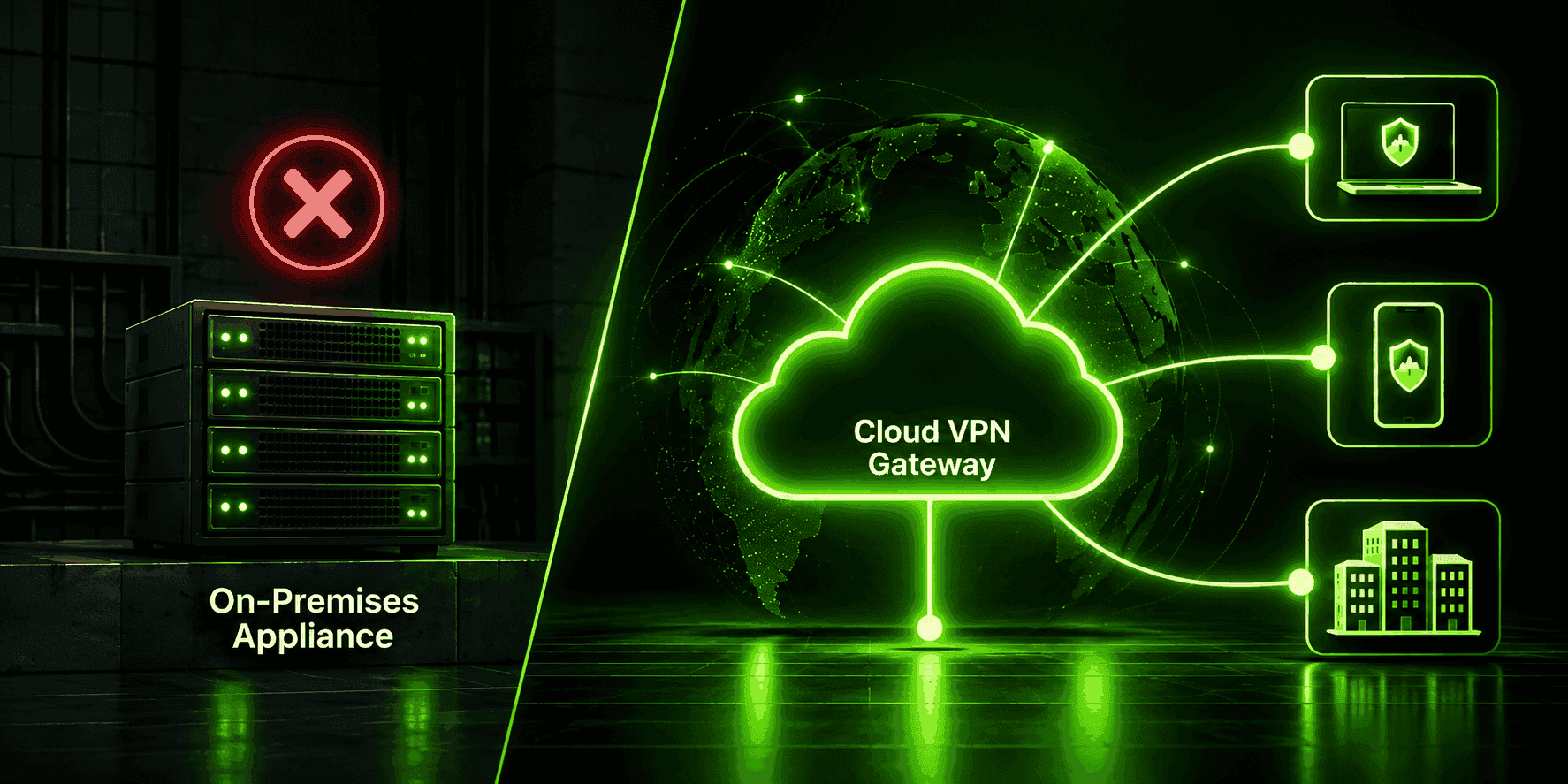
Cloud providers have their own answer to the same aggregation problem, and AWS is a useful example of how it plays out at scale. Rather than deploying physical hardware, AWS Site-to-Site VPN Concentrators are built around AWS Transit Gateway — a managed service that acts as a central hub connecting multiple VPCs, on-premises networks, and VPN connections without requiring a customer to run or patch any concentrator hardware themselves.
In this model, each on-premises location establishes its own site-to-site VPN connection into the Transit Gateway, which then handles the routing, encryption endpoint management, and scaling behind the scenes. For an organization already running infrastructure on AWS, this removes a substantial amount of operational overhead: no capacity planning for physical units, no manual failover configuration, and tunnel counts that can grow well past what a single on-premises appliance would comfortably support. It's the same underlying concept as a hardware or virtual concentrator — aggregating many encrypted connections into one managed point — just delivered as a cloud service instead of infrastructure you own.
AWS's dedicated Site-to-Site VPN Concentrator capability comes with specific, documented limits worth knowing if you're actually evaluating it: it's built exclusively on top of Transit Gateway (it isn't available as a standalone feature), supports roughly 5 Gbps of aggregate bandwidth across all connected sites, caps throughput at around 100 Mbps per individual site connection, requires BGP for routing rather than static routes, and is generally positioned for deployments of 25 or more site connections — below that threshold, a standard Transit Gateway VPN attachment without the concentrator-specific tooling is usually simpler and sufficient. Those numbers matter because they define a fairly specific sweet spot: large enough to justify centralized management, but each individual site's bandwidth needs staying modest enough that the per-site cap doesn't become a bottleneck.
When Do You Actually Need a VPN Concentrator?
For most of the site-to-site scenarios above, the decision isn't really a judgment call — it's dictated by scale. Security research on remote-access deployments generally puts the threshold somewhere around 100 or more simultaneous remote connections before a purpose-built concentrator starts paying for itself over simpler VPN gateway software. Below that number, a standard firewall's built-in VPN capability, or a modest software VPN server, usually handles the load without breaking a sweat.
Site-to-site deployments follow a similar logic, just measured differently. Once an organization is managing 25 or more site-to-site tunnels — a retail chain connecting dozens of store locations back to a central data center, a hospital network linking clinics and diagnostic labs, an airport tying together terminals, cargo facilities, and administrative buildings — the tunnel-management overhead alone becomes a strong argument for centralizing everything behind dedicated concentrator hardware or a virtual concentrator instance. It's not just about raw throughput; it's about having one place to configure routing policy, monitor tunnel health, and roll out changes instead of touching two dozen separate firewalls by hand.
High availability tends to enter the picture at the same point. Enterprise concentrator deployments are commonly configured in active/active pairs (both units passing traffic simultaneously, sharing the load), active/passive pairs (a standby unit ready to take over instantly if the primary fails), or full load-balancing clusters that spread thousands of tunnels across several concentrators. The mechanics behind that failover are usually familiar to any network engineer: VRRP (Virtual Router Redundancy Protocol) handles the standby unit taking over a shared IP address if the primary goes dark, IKE-level HA keeps existing tunnel state synchronized between units so a failover doesn't force every connection to renegotiate from scratch, and several vendors layer their own branded fast-failover features on top to shrink the gap even further. None of this is exotic — it's the same high-availability thinking IT teams already apply to core switches or database servers, just extended to the VPN layer because a concentrator outage would otherwise take down connectivity for every branch or remote worker behind it at once.
If none of that describes your situation — you're not managing dozens of site-to-site tunnels, you don't have IT staff provisioning failover pairs, and "remote access" for you means your own laptop and phone rather than a distributed workforce — a concentrator solves a problem you don't have.
VPN Concentrator vs. a Personal VPN
This is where the two technologies get confused most often, so it's worth being direct about the difference. A VPN concentrator's job is to take many incoming connections — from branch offices, remote employees, or partner networks — and route them securely into one organization's internal network. It's infrastructure that a company operates on its own network edge, and the traffic it manages belongs to other people: employees, contractors, site-to-site partners.
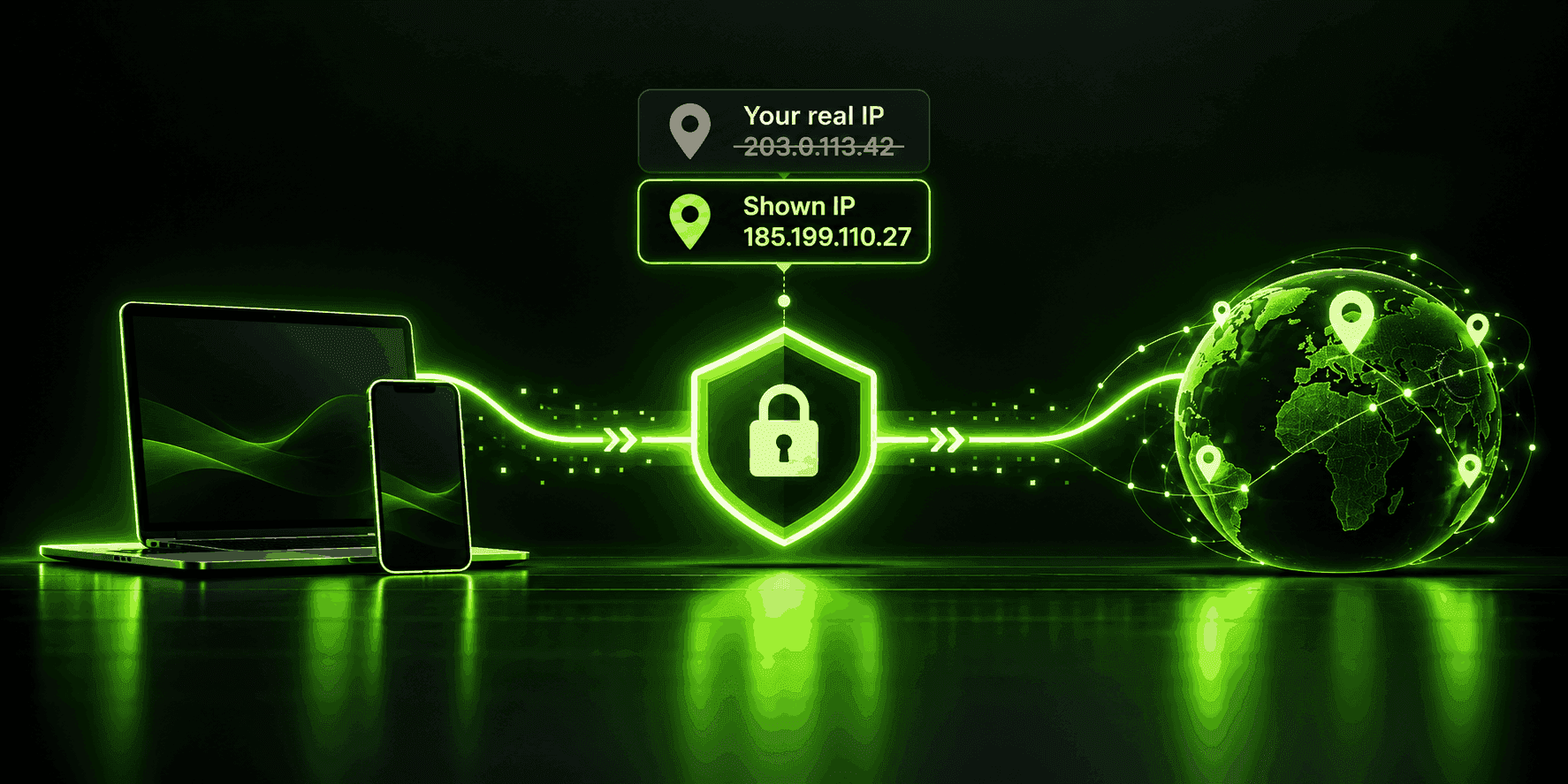
A personal VPN app like Guru VPN does something else entirely. Instead of terminating other people's connections, it protects one person's own outbound traffic — encrypting what leaves your device and routing it through a server you've chosen, so your browsing isn't exposed on whatever network you're connected to. There's no fleet of incoming tunnels to manage, no site-to-site routing table, no failover pair to configure. It's a single encrypted connection between your device and a server, built for individual privacy rather than corporate network access. Setting it up takes about as long as installing Guru VPN and picking a location, not provisioning hardware or configuring IKE policies.
Why Most People Don't Need a VPN Concentrator
If you've read this far wondering whether your home office or small team needs concentrator-grade infrastructure, the honest answer is almost certainly no — and that's a good thing, because it means the solution is much simpler than anything described above. What you actually need is reliable encryption for your own traffic, servers in the locations you care about, and an app that doesn't require a networking background to configure.
| Need | VPN Concentrator | Guru VPN |
|---|---|---|
Who it protects | An entire organization's incoming traffic | Your own device's outbound traffic |
Typical user | IT/network administrators | Individuals, freelancers, small teams |
Setup complexity | Requires provisioning, IKE policy, routing tables | Install, choose a server, connect |
Hardware required | Often yes (or a virtual instance) | No — runs as an app |
Cost model | Enterprise licensing/hardware budget | Straightforward consumer plans |
Guru VPN focuses on that everyday side of the problem: strong encryption on every connection, a wide spread of server locations so you're never far from a fast one, and a pricing structure built around individuals rather than enterprise procurement cycles. It's worth comparing the current Guru VPN plans against how often you actually connect — casual users and daily remote workers tend to land on different tiers. You can see the full breakdown, including what's bundled at each level, on the pricing page, and check the spread of available locations on the server list before deciding if it covers the regions you need.
Frequently Asked Questions
They're used to consolidate large numbers of incoming VPN connections — from remote employees or branch offices — into a single, centrally managed point on an organization's network, handling authentication, encryption, and tunnel routing at scale.
A hardware concentrator is dedicated physical equipment built for high-throughput VPN processing, while a virtual VPN concentrator is software running on a virtual machine or cloud instance — more flexible to scale, though typically capped by the underlying infrastructure's performance.
Rarely. Most small businesses fall well under the connection-count thresholds where a concentrator becomes cost-effective, and a standard firewall's VPN feature or a personal VPN app covers their needs at a fraction of the complexity.
Conceptually yes — both aggregate and manage multiple VPN tunnels — but AWS's version runs as a managed service through Transit Gateway rather than physical appliances you own and maintain.
Conclusion
VPN concentrators solve a specific, large-scale problem: securely connecting dozens or hundreds of remote sites and users into one organization's network without turning that management task into chaos. Whether that's handled by dedicated hardware, a virtual instance, or a managed cloud service like AWS's Transit Gateway option, the underlying job is the same — centralize, authenticate, encrypt, and route. For anyone outside that enterprise scale, though, the far simpler and more practical answer is a personal VPN that protects your own traffic without any of the infrastructure overhead. Guru VPN was built for exactly that everyday case.