 EN
 BR
 DE
 ES
 FR
 RU
 ID
 TR
 IT
 JP
 SA
 VN
 TH
 KR

Cloud VPN Explained: How It Works, Cloud VPN Concentrators, and Business Use Cases

 Key takeaways

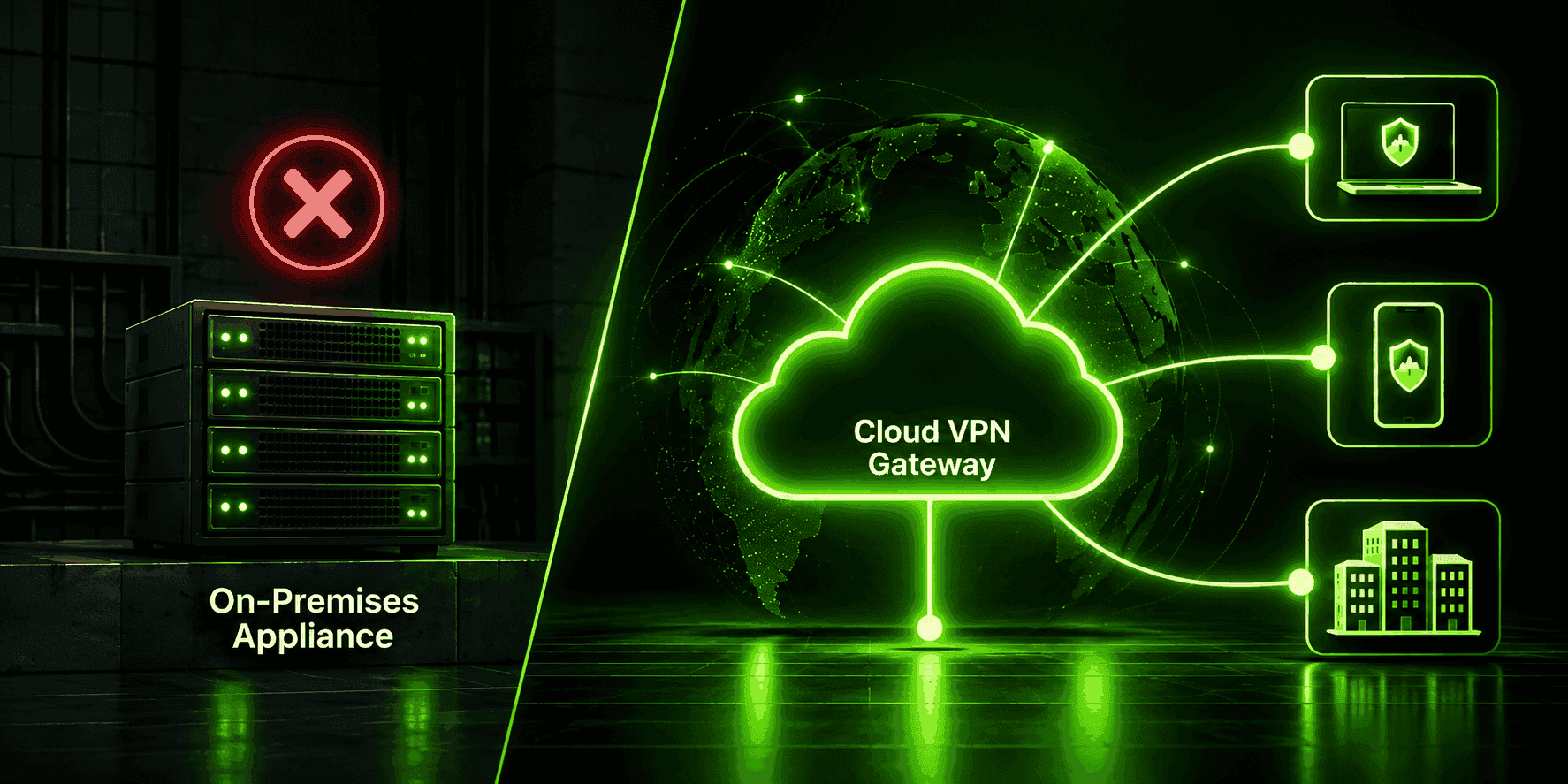
- A cloud VPN routes encrypted connections through a gateway hosted on cloud infrastructure, rather than a physical VPN appliance an organization owns and maintains on-site.
- Cloud VPNs typically come in two service tiers — high-availability configurations with redundant failover, and simpler "classic" configurations with a single connection point — and in two deployment patterns: remote-access (individual devices connecting in) and site-to-site (linking whole networks together).
- A cloud VPN concentrator is the cloud-hosted equivalent of the physical hardware that used to handle dozens or hundreds of simultaneous encrypted tunnels in a server room — the same job, without the box.
- Businesses use cloud VPNs for far more than remote worker access: BYOD support, connecting cloud and on-premises systems, partner and contractor access, and even geography-dependent tasks like checking localized content or pricing.
- Personal VPN services like Guru VPN are, functionally, a consumer-facing form of cloud VPN — you connect to infrastructure the provider runs and scales, without ever touching a server yourself.
A cloud vpn is, at its simplest, a VPN where the gateway your device connects to lives on cloud infrastructure instead of a physical appliance sitting in an office server room. For IT teams, that distinction is the whole point — it changes how the VPN gets deployed, scaled, and maintained. For individuals searching vpn cloud service or cloud based vpn service, though, the term usually means something more familiar: a VPN app, like Guru VPN, that connects you to servers a provider runs and maintains, rather than hardware you'd ever have to manage yourself. Both meanings are legitimate, and they're more related than they first appear. This guide covers what is a cloud vpn technically, how cloud vpn concentrators work, where cloud vpn for business actually gets used, how it ties into data security, and what's replacing it in modern enterprise architecture.
What Is a Cloud VPN?
What is a cloud vpn, exactly, beyond "a VPN that lives in the cloud"? It's a VPN gateway — the component that handles encryption, decryption, and authentication for every connecting device — that a cloud provider hosts and operates, instead of that same function running on a physical box an organization buys, racks, and maintains itself. The encryption and tunneling mechanics underneath are the same technology used in any VPN (commonly IPsec or SSL/TLS); what changes is where that gateway actually lives and who's responsible for keeping it running.
This matters more than it might sound, because a physical VPN appliance has a fixed capacity — it can only handle so many simultaneous encrypted connections before performance degrades, and scaling up means buying new hardware. A cloud vpn's gateway capacity, by contrast, scales the way most cloud infrastructure does: the provider adds resources behind the scenes as demand grows, without anyone having to plan a hardware refresh.
Cloud VPN vs. Traditional VPN
| Feature | Traditional (On-Premises) VPN | Cloud VPN |
|---|---|---|
Where the gateway lives | Physical appliance in an office or data center | Hosted on cloud infrastructure |
Setup | Requires purchasing, racking, and configuring hardware | Provisioned through a cloud console, typically in minutes |
Scaling | Requires new hardware as demand grows | Scales through the provider's existing infrastructure |
Maintenance | Falls on internal IT staff | Largely handled by the cloud provider |
Reliability | Single physical point of failure unless redundant hardware is purchased separately | Built on the provider's redundant, distributed infrastructure |
Upfront cost | Higher — hardware is a capital expense | Lower — typically a predictable operating expense |
The practical upshot is that a cloud based vpn setup removes most of the traditional VPN's operational burden — nobody has to plan hardware capacity, apply firmware patches to a physical appliance, or scramble to replace a failed unit — in exchange for depending on a third party's infrastructure and service reliability instead of infrastructure the organization directly controls.
Cloud VPN Service Tiers: High Availability vs. Classic
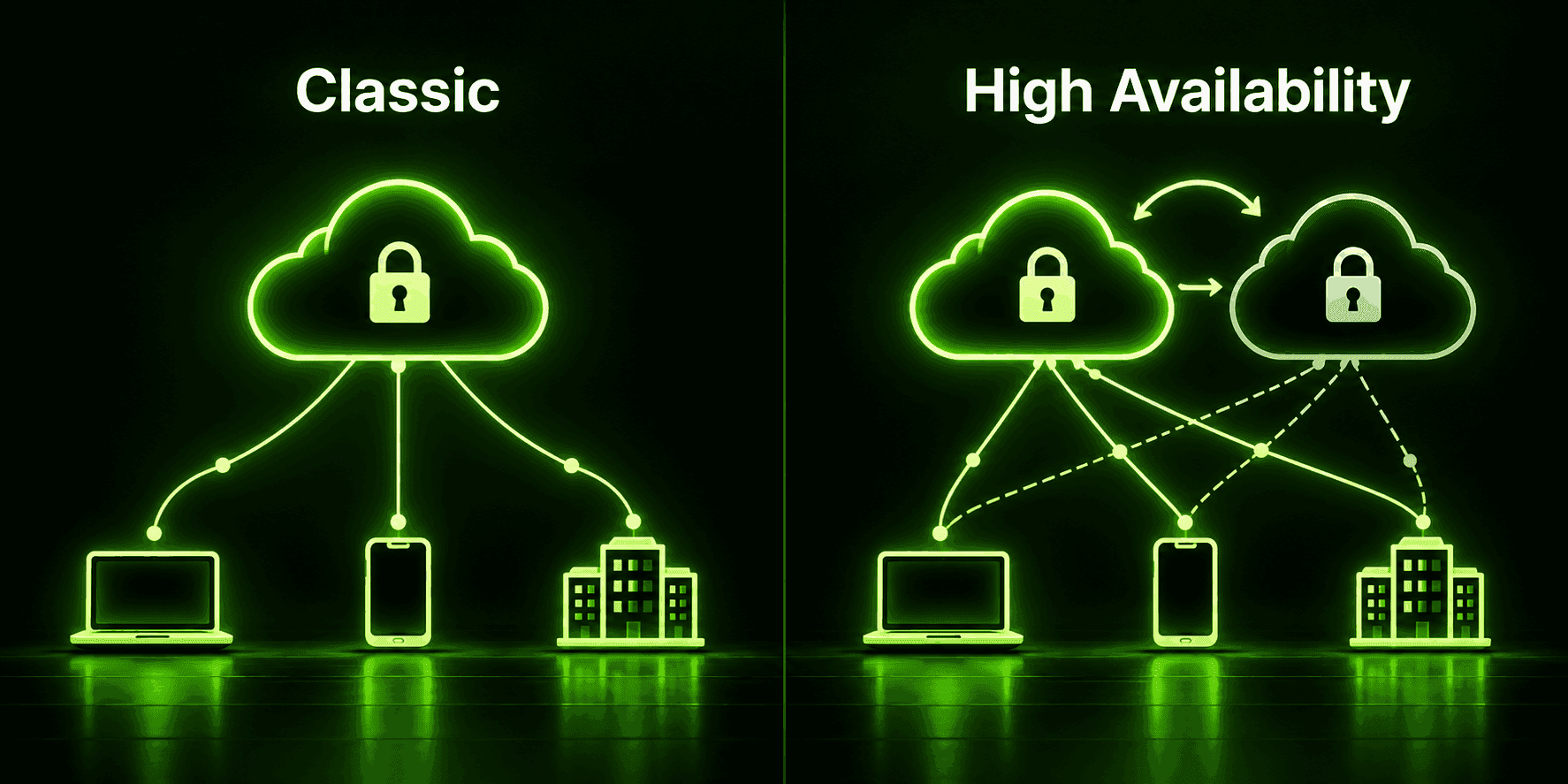
Most cloud VPN offerings come in two tiers, and the difference comes down to how much redundancy is built in. A high-availability (HA) cloud VPN configuration runs redundant gateway instances, arranged so a backup can either share the load continuously or simply take over the moment the primary instance fails, so that a single instance going down doesn't drop the connection — this tier commonly targets somewhere around 99.99% uptime. A classic (non-HA) configuration runs a single gateway instance with a single connection point, which is simpler and cheaper to configure but comes with a lower uptime target, typically around 99.9%, since there's no automatic failover if that one instance has a problem.
Which tier makes sense depends entirely on how much an interruption would actually cost. A business running customer-facing services through the tunnel usually can't tolerate the downtime a classic configuration risks, while a smaller deployment with less on-the-line urgency may not need to pay for redundancy it won't often use.
Two Ways Cloud VPNs Get Deployed
Separate from the tier question, a cloud VPN gets deployed in one of two patterns depending on what's actually connecting to it. A cloud based remote access vpn is what an individual device — an employee's laptop, for instance — connects to directly, similar in concept to any remote access VPN, just with the gateway itself living in the cloud rather than on-site. A site-to-site (sometimes called site-to-cloud) cloud VPN instead links two entire networks together — an office network and a cloud-hosted environment, for example — through a persistent tunnel between gateways, without requiring individual client software on every device at either end.
Many organizations run both patterns simultaneously: a persistent site-to-site tunnel keeping an office network and cloud resources continuously linked, plus a remote-access configuration layered on top for individual employees connecting from wherever they happen to be working.
What Is a Cloud VPN Concentrator?
The term cloud vpn concentrator refers to the specific function of terminating and managing large numbers of simultaneous encrypted tunnels at once — historically, a dedicated physical appliance built to handle exactly that job, since encrypting and decrypting traffic for dozens or hundreds of connections simultaneously is genuinely resource-intensive work. A cloud VPN gateway takes over that same concentrator function, but running on shared cloud infrastructure instead of a dedicated box, which is why cloud VPN documentation and traditional VPN documentation both still use "concentrator" as a description of the underlying job being done, even when there's no physical hardware left to point to.
The practical difference this makes: a physical concentrator has a hard ceiling on how many tunnels it can handle before you need a second unit, while a cloud-hosted concentrator function can generally absorb more simultaneous connections by drawing on additional cloud resources, without anyone needing to notice the transition happening.

Cloud VPN for Business: Where It Actually Gets Used
Cloud vpn for business use cases go well beyond the obvious "let employees work from home" scenario, even though that's usually the first one people think of.
Distributed and remote workforce access is the baseline case — employees connecting securely to internal systems regardless of physical location, without the company needing a VPN appliance sized for a specific office headcount.
BYOD support is a closely related case: a cloud VPN's scalable, centrally managed nature makes it easier to extend secure access to a wider range of personal devices without the capacity planning a fixed appliance would require.
Connecting cloud and on-premises systems is a case unique to hybrid infrastructure — a site-to-site cloud VPN can link a company's still-existing on-site servers to newer cloud-hosted applications, letting both environments function as one network during a gradual cloud migration.
Contractor and partner access benefits from the same scalability and central management — granting and revoking access for a rotating set of external collaborators is far simpler through a cloud-managed gateway than through appliance-level configuration changes.
Geography-dependent business tasks are a less obvious but genuinely common case: teams use cloud VPN connections to check how content, pricing, or search rankings appear from different regions, to test how a product behaves under different geolocation assumptions, or to reach region-specific services that aren't accessible from their actual location.
Cloud VPN and Cloud Data Security
Security cloud data with vpn strategies generally treat the VPN as one layer of a larger picture, not the whole solution. The VPN itself handles two specific jobs: encrypting data in transit between a device and the cloud-hosted resources it's reaching, and gating who's allowed to establish that connection in the first place through authentication. Cloud security vpn setups pair this with practices that live outside the tunnel entirely — multi-factor authentication so a stolen password alone can't grant access, network segmentation so a compromised device or account can't reach more than it needs to, and firewall rules at the gateway itself limiting what kinds of traffic are allowed through at all.
It's worth being clear about what a VPN doesn't cover on its own: data sitting at rest in cloud storage, misconfigured cloud permissions, and application-level vulnerabilities are all separate risks a VPN's encrypted tunnel has no bearing on. A cloud VPN secures the connection; it doesn't automatically secure everything on either end of it.
Modern Alternatives to Cloud VPN
A cloud vpn alternative gaining real traction in enterprise environments is Zero Trust Network Access (ZTNA), which changes the underlying trust model rather than just moving infrastructure to the cloud. Where a VPN — cloud-hosted or not — typically grants a connected device broad access to a network segment once it's authenticated, ZTNA verifies the user, device, and specific application being requested continuously, and grants access only to that one application rather than the wider network. Some vendors package this together with broader networking functionality into a Secure Access Service Edge (SASE) framework, combining connectivity and security into a single cloud-delivered service.
Neither of these fully replaces cloud VPN for every use case today — most organizations run VPN and ZTNA side by side during a gradual transition rather than switching over all at once — but the direction of enterprise architecture is clearly toward narrower, continuously-verified access rather than broad access granted once and trusted for the life of the connection.
Is a Personal VPN Like Guru VPN a "Cloud VPN"?
In the sense that matters practically: yes. When you connect to Guru VPN, you're connecting to server infrastructure the provider runs, maintains, and scales — you never touch a physical box, request capacity, or manage a gateway yourself, which is exactly the underlying idea behind cloud vpn as a service model. The difference from the enterprise version of the term is really just scope: a personal cloud based vpn service protects one individual's traffic and privacy, while an enterprise cloud VPN connects a workforce to internal company systems.
That distinction matters in practice: a personal VPN won't grant you access to a company's internal network the way an enterprise remote-access cloud VPN would, since that requires your employer's own gateway, credentials, and configuration. What it does the same way any cloud VPN does is handle the encryption and connection management on infrastructure you never have to think about — checking the available server locations and comparing plans on the pricing page is the entire extent of the "setup" most people ever need to do.
Frequently Asked Questions
It's a VPN where the gateway that handles encryption and connections is hosted on cloud infrastructure rather than a physical appliance an organization owns and maintains itself.
The underlying encryption technology is the same. The difference is where the gateway lives and who maintains it — a cloud VPN's infrastructure is hosted and scaled by a provider, while a traditional VPN's hardware sits on-site and is managed internally.
It's the function of handling many simultaneous encrypted VPN connections at once — historically done by dedicated physical hardware, now typically handled by a cloud-hosted gateway drawing on shared cloud infrastructure instead.
They share the same underlying model — connecting to provider-hosted infrastructure instead of managing your own — but they serve different purposes. A personal VPN like Guru VPN protects an individual's own traffic; an enterprise cloud VPN connects a workforce to internal company systems.
Zero Trust Network Access (ZTNA), sometimes bundled into a broader SASE framework, is the main alternative gaining adoption — it grants continuously-verified, per-application access rather than broader network access once a device connects.
Conclusion
Cloud vpn ultimately describes a shift in where the VPN's gateway lives and who's responsible for keeping it running, not a fundamentally different kind of encryption or security. For a business, that shift means trading hardware ownership and capacity planning for a provider's scalability and maintenance, with a real comparison to make against newer, narrower-access models like ZTNA. For an individual, it means something simpler and already familiar: a personal VPN like Guru VPN has been running on this same cloud-hosted model all along, just without ever needing to explain it in those terms.