 EN
 BR
 DE
 ES
 FR
 RU
 ID
 TR
 IT
 JP
 SA
 VN
 TH
 KR

What Is VPN Encryption? How It Works, Types, and Which Protocol Is Most Secure

 Key takeaways

- Understand what VPN encryption actually does, and why it's just one part of a secure VPN connection.
- Learn the difference between symmetric encryption (AES, ChaCha20) and asymmetric encryption (RSA) used in the handshake.
- See how encryption protocols for VPN connections — OpenVPN, WireGuard, IKEv2, and older options — compare in strength and speed.
- Find out what actually makes one VPN encryption setup more secure than another.
- Get a clear answer on which is the best VPN encryption protocol for everyday use.
Every time someone recommends a VPN, encryption gets mentioned as the reason it's safe — but few explanations go further than "it scrambles your data." Understanding what is VPN encryption in practical terms means looking at what's actually happening to your traffic: which algorithm is doing the scrambling, how your device and the VPN server agree on a secret key in the first place, and why some protocols are considered stronger than others.
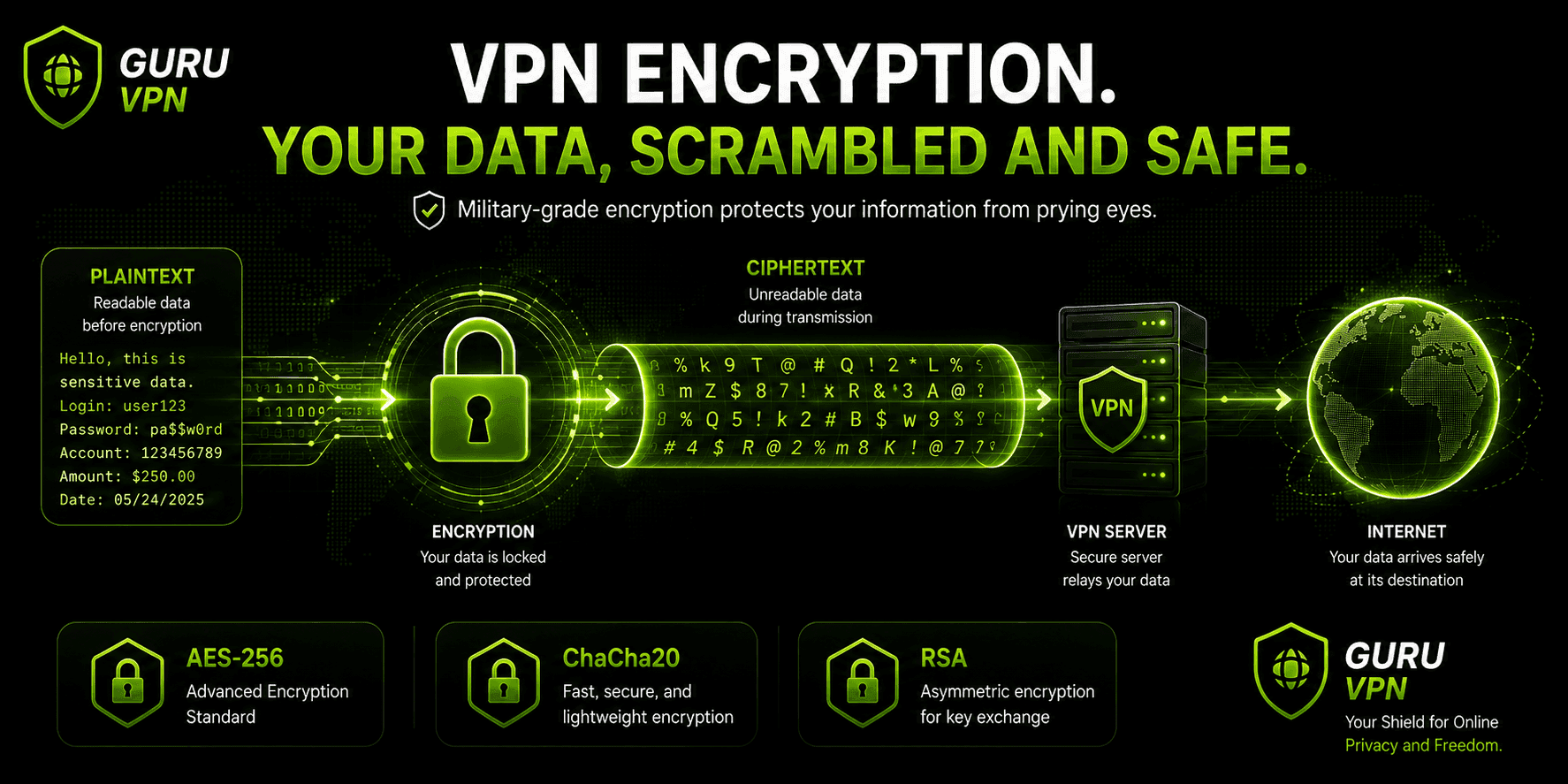
At its core, VPN encryption takes readable data and transforms it into ciphertext — something that looks like random noise to anyone intercepting it, whether that's your internet provider, someone on the same public Wi-Fi network, or an attacker running a packet sniffer. Only your device and the VPN server hold the key needed to turn that noise back into readable data.
Modern apps like Guru VPN handle all of this automatically in the background, but knowing the basics makes it much easier to judge whether a VPN's security claims actually hold up.
Key Takeaways
- Understand what VPN encryption actually does, and why it's just one part of a secure VPN connection.
- Learn the difference between symmetric encryption (AES, ChaCha20) and asymmetric encryption (RSA) used in the handshake.
- See how encryption protocols for VPN connections — OpenVPN, WireGuard, IKEv2, and older options — compare in strength and speed.
- Find out what actually makes one VPN encryption setup more secure than another.
- Get a clear answer on which is the best VPN encryption protocol for everyday use.
How Does VPN Encryption Work?
VPN tunnel encryption relies on two different types of cryptography working together, each solving a different problem.
Symmetric encryption uses a single shared key to both encrypt and decrypt data. It's fast and efficient, which is why it handles the actual bulk of your traffic once a connection is established. AES (Advanced Encryption Standard) and ChaCha20 are the two algorithms you'll run into most often, and both are considered part of the strongest encryption for VPN traffic available today.
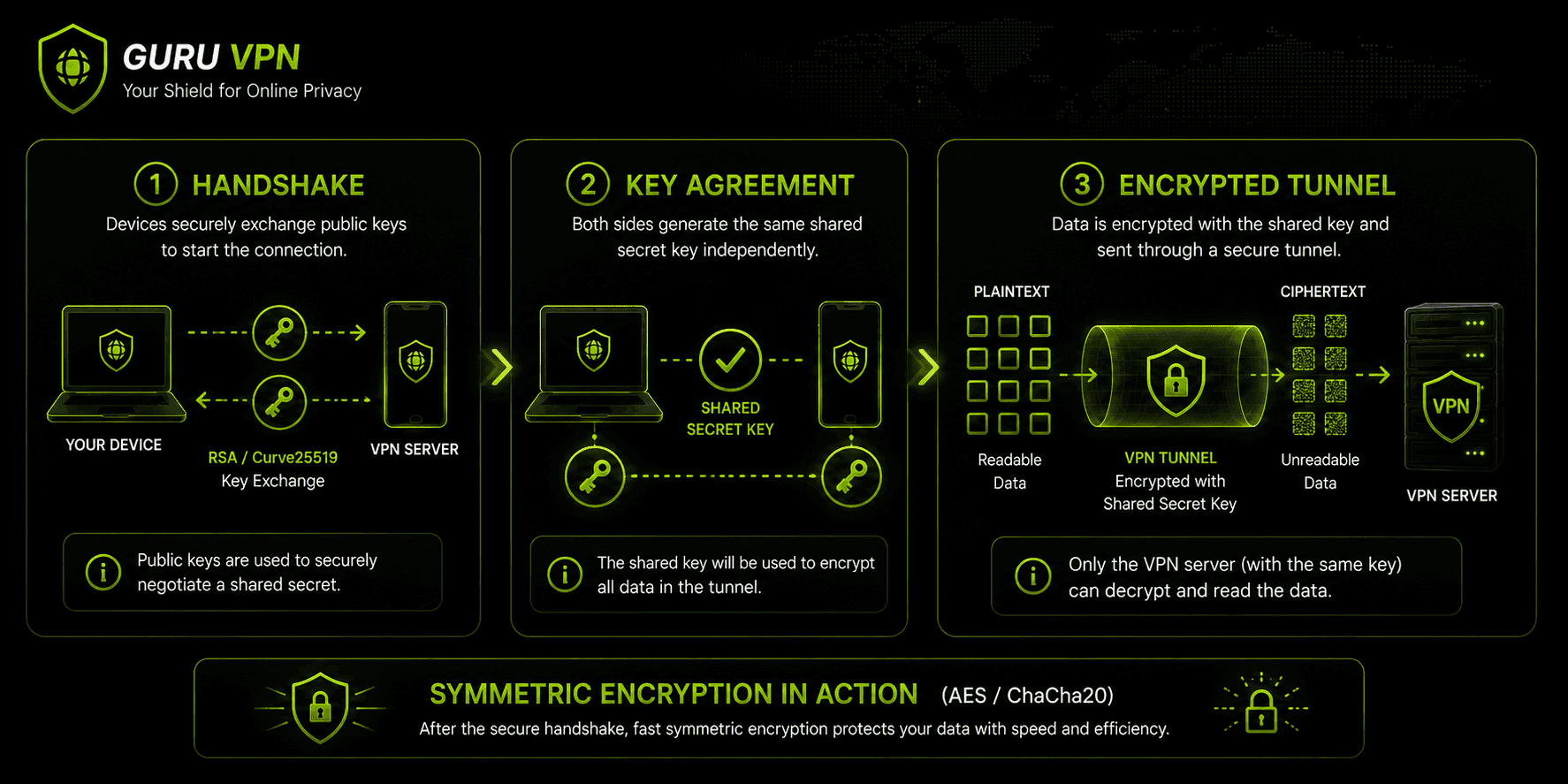
Asymmetric encryption uses a pair of keys — one public, one private. It's slower, so VPNs don't use it to encrypt your actual browsing traffic. Instead, it handles the handshake: the initial process where your device and the VPN server securely agree on a shared symmetric key without ever transmitting that key in a form an attacker could intercept. RSA is the most common algorithm used here, though modern protocols increasingly favor Curve25519 for the same job with better performance.
Putting it together, a typical connection looks like this: your device contacts the VPN server and the two authenticate each other, they perform a key exchange using asymmetric cryptography to agree on a session key, and from that point on every packet of your data is encrypted with that key using a fast symmetric cipher before entering the tunnel. When it reaches the VPN server, it's decrypted and forwarded to its destination — and the whole process reverses for data coming back.
A third approach, Diffie-Hellman key exchange, gets to the same result differently: instead of encrypting a key and sending it across, both sides each generate a private number, exchange a mathematically derived public value, and separately calculate the exact same shared secret on their own — a secret that was never actually transmitted in any form, encrypted or otherwise. That's part of why Diffie-Hellman is often paired alongside RSA in IKEv2/IPsec implementations for extra assurance during the handshake.
VPN Encryption Types and Protocols
Not every VPN protocol implements encryption for VPN traffic the same way, and different vpn encryption protocols strike very different balances between speed and security. The most common encryption protocols for VPN connections today are:
OpenVPN — often called the gold standard historically, OpenVPN typically uses AES-256-GCM for the data channel alongside a separate, strong handshake (commonly RSA-4096). It's open-source, thoroughly audited, and considered extremely secure, though not the fastest option available.
WireGuard — the newer, leaner alternative. It uses ChaCha20 for encryption and Curve25519 for key exchange, a pairing chosen specifically for speed on mobile devices without giving up cryptographic strength. Most modern VPN apps, including Guru VPN, favor WireGuard as their default for this reason.
IKEv2/IPSec — pairs well with mobile use since it reconnects quickly after network changes (like switching from Wi-Fi to cellular), typically using AES for encryption.
L2TP/IPSec — an older pairing that encrypts both packet data and headers, generally considered secure but slower due to double encapsulation.
SSTP — Microsoft's proprietary protocol, AES-based, mainly useful on Windows and for getting past network restrictions since it disguises traffic as regular HTTPS.
PPTP — the oldest protocol on this list, with weak, outdated encryption. It's fast but shouldn't be used where any real security matters.
| Protocol | Encryption | Key Exchange | Typical Use |
|---|---|---|---|
WireGuard | ChaCha20 | Curve25519 | Speed + strong security, everyday use |
OpenVPN | AES-256-GCM | RSA-4096 | Maximum audited security |
IKEv2/IPSec | AES | Diffie-Hellman | Mobile devices, network switching |
L2TP/IPSec | AES (double encapsulation) | Pre-shared key | Legacy compatibility |
SSTP | AES | RSA | Windows, bypassing restrictions |
PPTP | Weak, outdated | N/A | Avoid for anything sensitive |
AES vs. ChaCha20: Which Encryption Is Stronger?
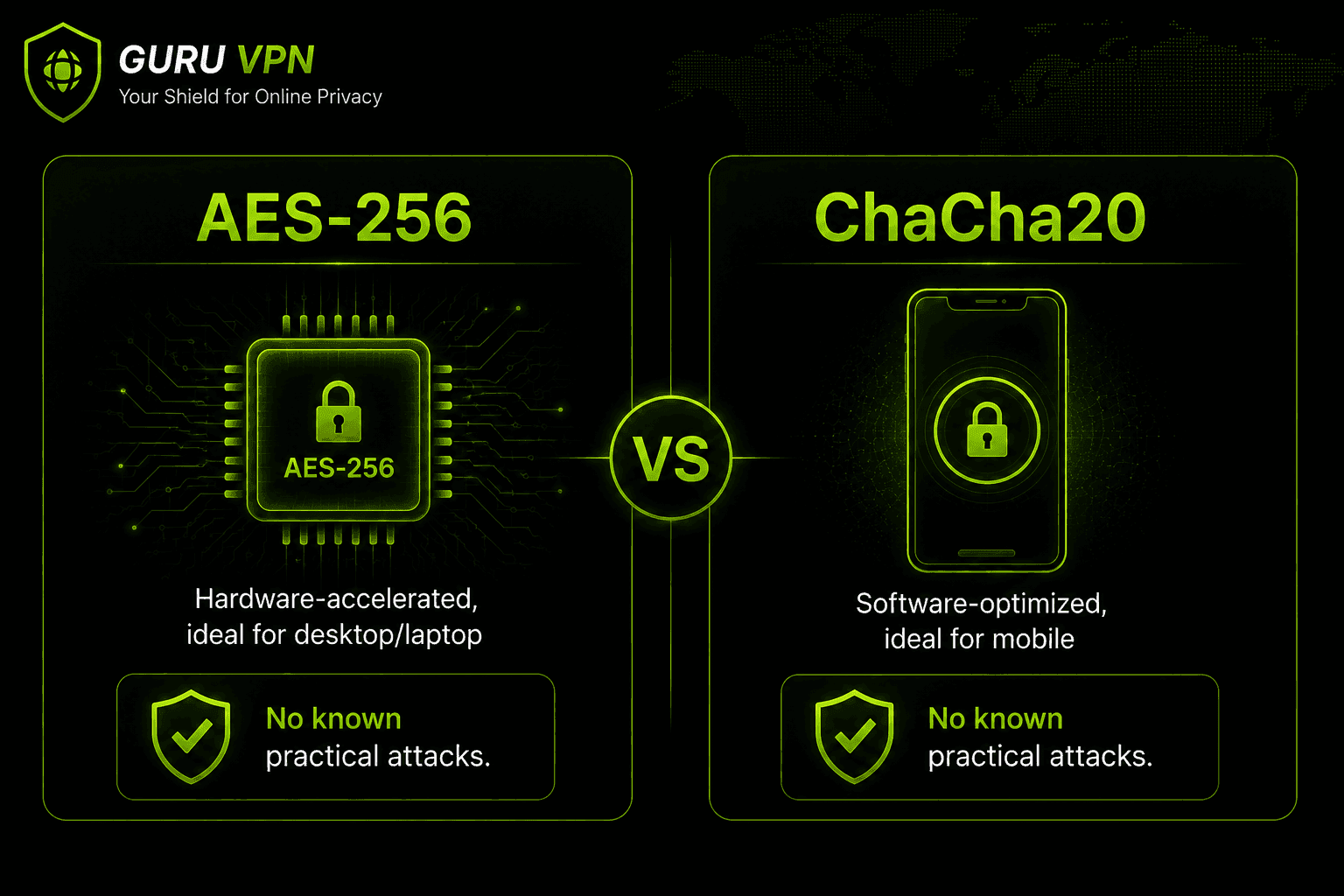
These are the two ciphers you'll see mentioned most in any serious comparison of VPN encryption, and the honest answer is that both are considered extremely secure at full strength — there's no known practical attack against either one today.
AES-256 is the U.S. government's own encryption standard, uses a 256-bit key, and benefits from hardware acceleration (AES-NI) built into most modern processors, which makes it very fast on desktops and laptops. ChaCha20 was designed to perform well without that dedicated hardware, which is why WireGuard pairs it with lighter devices like phones — it often runs faster there than AES would.
In practice, the choice between them says more about which protocol and device you're using than about a real difference in protection. A 256-bit key space means roughly 2^256 possible combinations — a number large enough that brute-forcing it isn't a realistic threat with any computing power available today or in the foreseeable future.
For context on why 256-bit specifically became the standard: AES also comes in a 128-bit key variant, which is still considered secure and was the default in many older systems. A 128-bit key space — roughly 2^128 combinations — is already astronomically large on its own, yet it's dwarfed by the 2^256 space a 256-bit key offers. That gap is why security-conscious VPNs default to AES-256 rather than AES-128 even though both remain unbroken by brute force today: the extra margin costs almost nothing in practice thanks to hardware acceleration, so there's little reason not to take it.
It's also worth addressing directly: neither AES-256 nor ChaCha20 has ever been practically broken. The real-world encryption failures people point to almost always involve older, weaker protocols like PPTP, or attacks that target flawed implementations and key management rather than the cipher itself. When a VPN service is compromised, the cause is typically a configuration mistake, a leaked key, or a vulnerability in surrounding software — not the underlying AES or ChaCha20 algorithm failing under direct attack.
What Makes VPN Encryption Most Secure?
A few factors matter more than the specific algorithm name on the box:
Key length — longer keys mean exponentially more possible combinations, which is why AES-256 is generally preferred over AES-128 for anything sensitive, even though both remain unbroken in practice.
Perfect Forward Secrecy — this generates a new, temporary session key for each connection, so even if one key were somehow compromised, it wouldn't expose past or future sessions. As a concrete example: imagine an attacker somehow obtained a VPN server's long-term private key a year from now. Without Perfect Forward Secrecy, they could theoretically use it to decrypt any of your traffic they'd recorded and stored in the meantime. With it, that stored traffic stays unreadable, because the actual session key used to encrypt it was unique to that one connection and was never stored anywhere to begin with. Most reputable modern VPNs implement this by default.
Avoiding outdated protocols — no encryption strength matters if it's wrapped in a protocol like PPTP, which has known, practical vulnerabilities regardless of key size.
Independent audits — open-source code and third-party security audits confirm that encryption is implemented correctly, not just claimed in marketing copy. Strong algorithms poorly implemented are a common source of real-world VPN weaknesses.
Will Quantum Computing Break VPN Encryption?
It's a fair question, since quantum computing comes up in almost every modern encryption discussion. The honest, current answer is: not yet, and not with technology that exists today. A sufficiently powerful quantum computer running Grover's algorithm could theoretically reduce AES-256's effective security to something closer to what AES-128 offers now — still an enormous space to search, and still far outside what's practically achievable with any hardware on the horizon. The bigger quantum concern is actually aimed at asymmetric algorithms like RSA, which a sufficiently mature quantum computer could theoretically break far more directly using Shor's algorithm. That's part of why the industry is already researching and rolling out post-quantum key exchange methods, but for now it's a forward-looking engineering concern rather than a reason to distrust the encryption a well-built VPN uses today.
Risks of Weak or Missing VPN Encryption
Without solid encryption, your internet provider can see every site you visit, anyone sharing a public Wi-Fi network with you can potentially intercept unencrypted traffic, and outdated protocols like PPTP can be cracked with tools that are widely available today. This is also where "free VPN" services often cut corners — advertising encryption without specifying the algorithm, protocol, or whether it's been independently verified at all. Anytime a VPN doesn't clearly state its encryption standard and protocol, that's worth treating as a red flag rather than an oversight. Choosing an encryption VPN provider comes down to protocol transparency as much as the algorithm itself.
Why Choose Guru VPN for Strong Encryption by Default
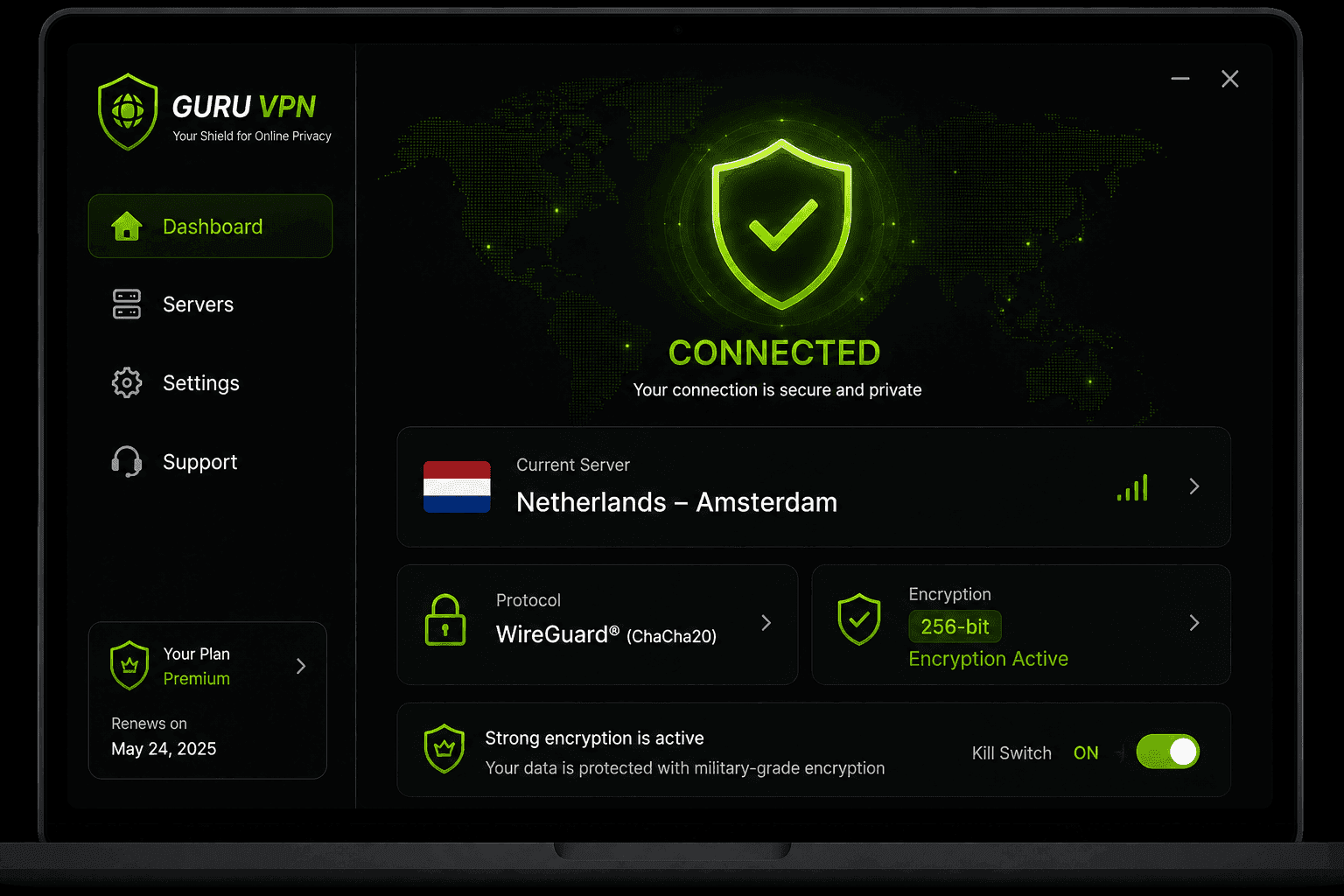
Knowing how encryption works is useful, but most people just want it handled correctly without having to think about it. Guru VPN uses WireGuard® with ChaCha20 encryption and Curve25519 key exchange as its default, giving you modern, independently-trusted cryptography without needing to pick protocols or ciphers manually.
| Feature | Benefit |
|---|---|
WireGuard® with ChaCha20 | Fast, modern encryption with no known practical attacks |
Strong key exchange | Secure handshake without exposing session keys |
Strict no-logs policy | Encryption protects your traffic; no-logs protects your history |
Fast global servers | Strong encryption without a noticeable speed penalty |
Cross-platform apps | Consistent protection on desktop and mobile |
Frequently Asked Questions
It's the process of converting your internet traffic into unreadable ciphertext so that only your device and the VPN server can read it, protecting your data from ISPs, attackers on public networks, and other third parties.
Your device and the VPN server first perform a handshake using asymmetric encryption to agree on a shared key, then use that key with a fast symmetric cipher — typically AES or ChaCha20 — to encrypt and decrypt your actual traffic for the rest of the session.
For most users, WireGuard offers the best overall balance of strong encryption and speed. OpenVPN remains an excellent, thoroughly audited alternative where maximum configurability matters more than raw speed.
AES-256 and ChaCha20 are both considered the most secure VPN encryption in practical use, with no known feasible attack against either at full key strength. Security in practice comes down more to protocol choice and implementation than to picking between these two.
Broadly, there's symmetric encryption (AES, ChaCha20), used for the bulk of your traffic, and asymmetric encryption (RSA, Curve25519), used during the handshake to safely exchange keys.
No. Encryption for VPN traffic protects the data itself, but a full security picture also depends on a no-logs policy, leak protection, and a kill switch — all things worth checking alongside whatever encryption VPN provider you choose.
No — they protect different parts of the journey. VPN encryption protects your traffic between your device and the VPN server; once your data leaves the server heading to its final destination, it's only as protected as that destination's own connection, such as whether the website itself uses HTTPS. End-to-end encryption, the kind a messaging app uses, protects data all the way from sender to recipient regardless of what network carries it in between. A VPN doesn't replace end-to-end encryption, and end-to-end encryption doesn't replace a VPN — they solve different problems and are often worth using together.