 EN
 BR
 DE
 ES
 FR
 RU
 ID
 TR
 IT
 JP
 SA
 VN
 TH
 KR

No-Log VPN Explained: What It Means and How to Tell If It's Real


 Key takeaways

- "No logs" isn't one single thing — it specifically means no activity/usage logs. Most providers, including the most privacy-focused ones, still retain some connection metadata briefly or in aggregated, non-identifying form.
- No VPN retains literally zero data. Billing details, an email address, and basic account information are the norm even under a strict no-log policy — the honest question is what's collected, not whether anything is.
- RAM-only (diskless) servers, independent third-party audits, and real-world legal tests are the three actual mechanisms that make a no-log claim verifiable rather than just a promise in a privacy policy.
- Jurisdiction matters as much as policy wording — a country with a mandatory data-retention law can override a no-log policy regardless of what a provider intends.
- The strongest evidence for a no-log claim isn't a slick FAQ page — it's a provider that's been legally compelled to hand over data and had nothing usable to give.
"No logs" might be the single most repeated phrase in VPN marketing, and also one of the least explained. You'll see it written as no-log vpn or no log vpn interchangeably — both describe the same idea, and some people search vpn no log instead, reversing the words, or vpn no log policy specifically, referring to the written policy document rather than the general concept. All of these point at the same underlying question: does this VPN actually know what you're doing online, and could it hand that information over if asked?
This article breaks down exactly what a no-log policy covers, what it deliberately doesn't, and — more usefully than most marketing pages — how you can actually check whether a "no-log" claim holds up rather than just taking it on faith.
What Is a No Log VPN?
A no-log VPN is a VPN provider that does not record what you do while connected — the sites you visit, the files you download, the apps you use, or your browsing history — and structures its systems so that information generally can't be reconstructed later, even if the provider is legally compelled to try. If you're asking what is no log vpn without the "a," it's the same question phrased slightly differently: a service built around collecting as little identifiable data about your online activity as its infrastructure allows.
That single-sentence definition is a reasonable starting point, but it hides most of the useful detail, and it's the reason the phrase gets thrown around so loosely. What's actually being logged (or not) breaks down into three distinct categories, and knowing the difference matters far more than the marketing phrase itself.
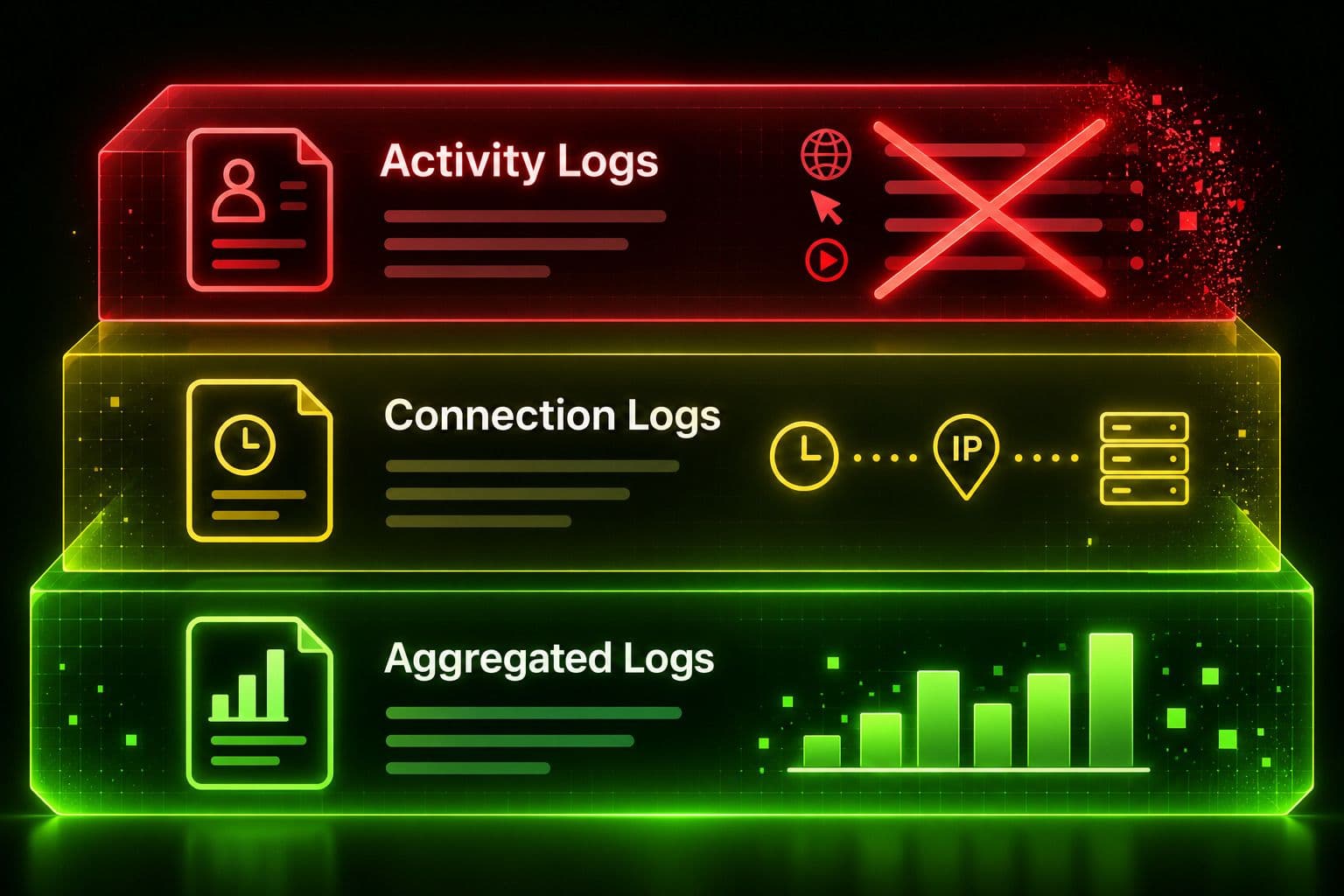
The Three Types of VPN Logs
Not all "logs" are created equal, and a provider can honestly claim "no logs" while still retaining some information, depending on which category it means.
| Log Type | What It Includes | Typical No-Log Policy |
|---|---|---|
Activity logs | Websites visited, files downloaded, apps used, DNS queries, search history | Genuinely no-log providers retain none of this, ever |
Connection logs (metadata) | Connection timestamps, session duration, data volume transferred, sometimes the originating IP address | Often retained briefly or not tied to identity; the point most worth scrutinizing closely |
Aggregated/anonymized logs | Total bandwidth across all users, server load, general usage trends, not attributable to any one person | Widely considered acceptable, since it can't be traced back to an individual |
The category that matters most for a truly private connection is the first one — activity logs are what would actually reveal what you did online, and a legitimate no-log VPN should not collect these under any circumstance. Connection metadata is where providers vary the most, and it's worth reading closely: a timestamp plus an originating IP address, even without any activity attached to it, can still be enough to narrow down who was connected at a given moment. Aggregated data, by contrast, genuinely can't identify anyone and is a normal, low-risk part of running server infrastructure at scale.
No Log VPN vs. Regular VPN: What's Actually Different
Every VPN encrypts your traffic and hides your IP address from the sites you visit — that part is identical regardless of logging policy. The difference between a no log vpn vs regular vpn setup comes down entirely to what happens on the provider's side of that connection after the encryption is stripped off at the server.
A difference between no log vpn and regular vpn provider isn't visible in speed, apps, or day-to-day use — it shows up only in what's retained in server logs and privacy policy documents, and in what could theoretically be handed over if a court or government ordered it. A "regular" VPN, in this context, usually means a provider that keeps some form of activity or detailed connection history for troubleshooting, abuse prevention, or its own analytics, and either says so plainly or is vague enough that it's unclear. That's not automatically malicious — some retention is genuinely useful for catching network abuse or fixing outages — but it means your online activity is, at least temporarily, something the provider could reconstruct, versus a genuine no-log VPN, where that information is designed never to exist in reconstructable form in the first place.
What Makes a No-Log Policy Real: Architecture and Jurisdiction
A no-log policy is a written promise. Two things turn that promise into something closer to a technical guarantee: how the servers are actually built, and which country's laws govern the company running them.
RAM-only (diskless) servers. Most privacy-focused providers now run their servers entirely in volatile memory (RAM) rather than on traditional hard drives. Because RAM only holds data while it's powered, everything on the server is wiped the moment it reboots or loses power, rather than sitting on a disk where it could be recovered later — including by the provider itself if it wanted to look. Not every credible approach relies on this exact method; a smaller number of providers use full-disk encryption instead, aiming for a similar end result (no persistent, readable data) through a different technical route. Either way, the point is the same: a no-log claim is stronger when the architecture makes retention difficult, not just against policy.
Jurisdiction. A no-log policy is only as strong as the law of the country enforcing it. Some countries have passed laws requiring VPN providers to log user activity and hand it over on request — India's 2022 data-retention directive is the clearest recent example, and it led several major VPN providers to withdraw their physical servers from the country entirely rather than comply, replacing them with virtual servers based elsewhere. Providers based in countries without mandatory retention laws for VPN services are in a meaningfully stronger position to keep a no-log promise, simply because no law forces them to break it.
How Do I Know If a VPN Is Truly No-Log?
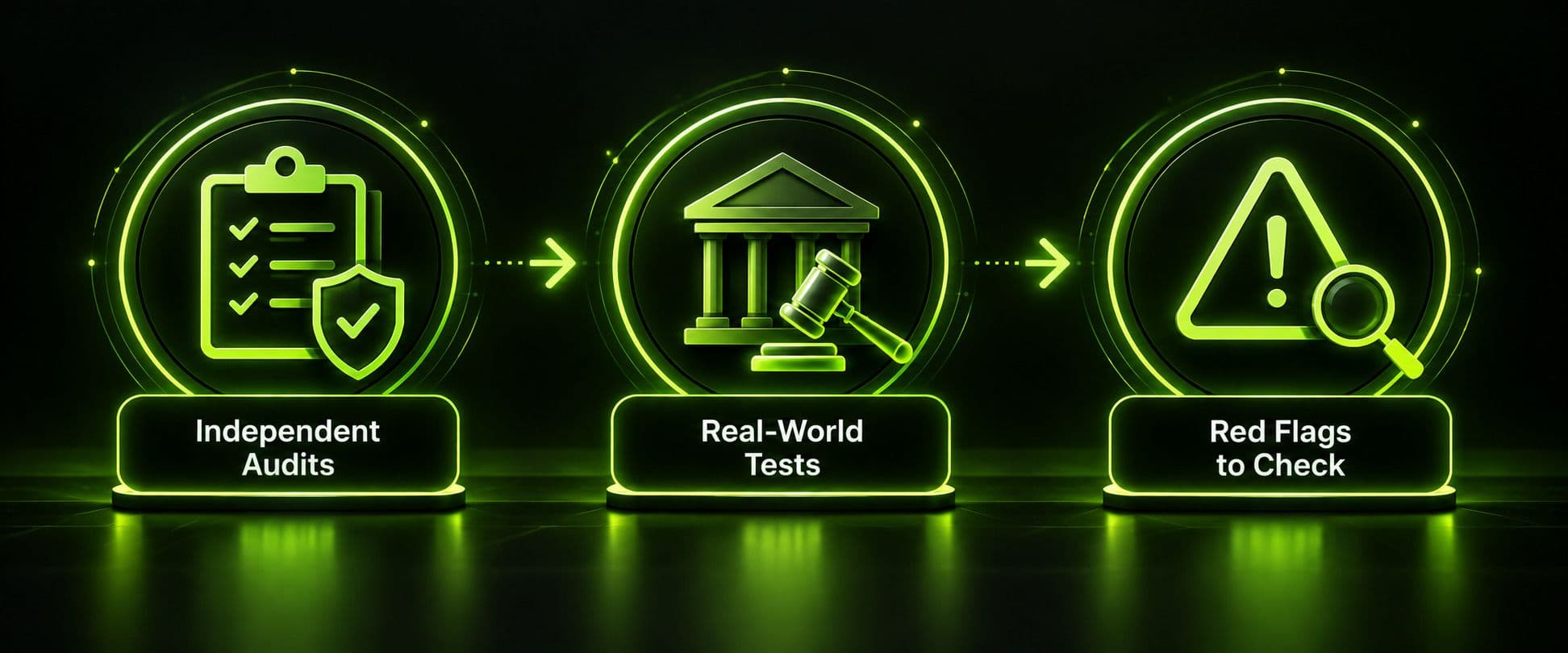
This is the question that actually matters, and it has a more concrete answer than "trust the privacy policy." Three forms of evidence, in roughly ascending order of how convincing they are, are worth checking for any no log vpn service you're evaluating.
1. Independent audits. A credible no-log claim has been examined by an outside firm with no financial stake in the outcome — names like KPMG, PwC, Deloitte, and Cure53 show up regularly in this space as firms that specialize in this kind of review. An audit typically involves inspecting server configurations, source code, and infrastructure to confirm that activity logging genuinely isn't happening, then publishing a summary of the findings. The honest limitation here is that an audit is a snapshot: it reflects what a provider's systems looked like on the specific days the auditor was looking, not an ongoing, live guarantee. A provider that's been through multiple audits over several years, rather than a single one-off review, is generally a stronger signal than a single audit alone.
2. Real-world tests. The stronger form of proof is a case where a provider was legally compelled — through a court order, a subpoena, or a physical server seizure — to produce user data, and simply had none to give. Several VPN providers have publicized incidents along these lines over the past decade: cases involving law enforcement requests, server seizures during criminal investigations, and court orders in multiple countries have reportedly ended with the provider handing over only account or billing information, because no activity logs existed to hand over in the first place. Unlike an audit, this kind of test is unplanned and adversarial — nobody scheduled it, and the provider had every incentive to comply fully if it could. That makes it a meaningfully different, and often more convincing, category of evidence than a commissioned audit, even though the two aren't mutually exclusive — the strongest providers tend to have both.
3. Red flags that should make you skeptical. A handful of providers have had their no-log marketing directly contradicted by evidence: cases have been reported of VPN services turning over usage data to law enforcement investigations even while their marketing promised otherwise, and at least one provider's own leaked database was found to contain detailed connection logs it had publicly claimed not to keep. In most of these cases, the providers involved later overhauled their privacy policies and pursued independent audits — which is itself informative: a past incident followed by real changes and subsequent audits is a different situation than a provider with no audit history and no way to check its claims at all. Vague privacy-policy language ("we may retain data as necessary"), no audit history whatsoever, and a jurisdiction with mandatory data-retention laws are the three most common warning signs worth checking before trusting a no-log claim at face value.
You may also come across the term "warrant canary" — a now largely outdated technique where a provider published a regularly updated statement confirming it hadn't received a secret government data request, on the theory that a missing update would silently signal something had changed. Most providers have moved away from this in favor of recurring audits and transparency reports, which are considered more informative and harder to game.
What a No-Log Policy Doesn't Cover
Even a genuinely well-run no-log VPN isn't collecting literally zero information, and any provider claiming otherwise isn't being fully straightforward. A few categories of data sit outside what a no-log policy typically addresses:
- Billing and account information. Payment details, an email address, and basic account data are necessary to run a subscription business and are retained by essentially every VPN, no-log or not.
- Customer support interactions. If you contact support through live chat or email, that conversation — and whatever third-party tool handles it — is a separate system from the VPN's own server infrastructure, and it isn't automatically covered by a "no activity logs" promise.
- Payment processors. Whichever service actually handles the transaction (a card processor or payment platform) has its own data-retention practices, entirely outside the VPN provider's own no-log policy.
None of this contradicts a genuine no-log policy — it simply means "no logs" specifically refers to what happens to your traffic and browsing activity once you're connected, not every piece of data that touches the business in any form. Understanding that distinction is part of what separates a genuinely informed reading of a privacy policy from just skimming the headline claim, whether you're reading it on Guru VPN or anywhere else.
Why Choose Guru VPN
Guru VPN is built around a no-logs approach: your browsing activity, the sites you visit, and what you do while connected aren't recorded or retained. What we do need to operate the service — basic account and billing information — is kept to what's necessary to run a subscription, nothing more, in line with the same distinction described above between a no-log policy and the handful of things it was never meant to cover.
If privacy is the reason you're looking at a VPN in the first place, it's worth applying the same evaluation framework from this article to any provider you're considering, Guru VPN included: look at what's actually collected, not just the headline phrase on the homepage. You can review the current plans on the Guru VPN pricing page and see the full list of available locations at guruvpn.com/servers.
FAQ
A no-log VPN doesn't record your browsing activity, so there's nothing detailed to hand over if the provider is ever legally compelled to disclose user data. It matters because a VPN sees all of your unencrypted traffic before it re-encrypts and forwards it — if that provider is also keeping detailed records, you've effectively just moved who can see your activity, rather than actually protecting it.
Most established VPN providers advertise some form of no-log policy today, but the wording and the strength of that claim vary significantly. Rather than looking for a single "correct" answer, check whether a specific provider has published independent audit results, has a track record of real-world legal tests, and operates from a jurisdiction without mandatory data-retention laws — the three checks covered earlier in this article.
Approach free VPN services with more scrutiny than paid ones. Running server infrastructure costs money, and a free service has to fund that cost somehow — sometimes through legitimate limitations (fewer servers, slower speeds), and sometimes through data collection or advertising that runs counter to a genuine no-log claim. A free tier with a clearly published audit and a specific, detailed privacy policy is a meaningfully different situation than one with vague terms and no independent verification at all.
In theory, a government could compel a provider operating within its jurisdiction to begin logging going forward, which is exactly why jurisdiction matters as much as the policy itself. What a no-log architecture generally protects against is retroactive disclosure — since past activity was never recorded, there's nothing historical to hand over even under a new legal order.
No. A no-log VPN prevents the provider itself from building a record of your activity, and it hides your IP address and encrypts your traffic from your internet provider and anyone on the same network. It doesn't stop websites from tracking you through cookies or account logins, and it isn't a substitute for other privacy practices if full anonymity is the actual goal.
A privacy policy tells you what a company says it does. Independent audits and real-world legal tests are closer to evidence of what a company's systems actually do — the gap between those two things is exactly why several well-marketed "no-log" VPNs have historically been shown to log more than they claimed.
Conclusion
"No logs" is a real, meaningful distinction, but only when it's backed by something more concrete than the phrase itself — a clear breakdown of exactly which log types are and aren't collected, server architecture that makes retention difficult rather than just against policy, a jurisdiction without a legal requirement to log, and ideally both an independent audit and a track record of holding up under real legal pressure. Any provider, Guru VPN included, is worth evaluating against that same checklist rather than the marketing headline alone — that's the difference between choosing a VPN because it says the right thing and choosing one because it can actually back it up.