
 BR
BR DE
DE ES
ES FR
FR RU
RU
Articles
Fake and Scam Websites: How to Spot Them and Stay Safe Online

Guru VPN experts
20.01.2026
When people talk about VPNs, encryption is usually mentioned as something obvious - something that’s just there. But in reality, the type of encryption a VPN uses directly affects how private and fast your connection actually is.
Every time you connect through a VPN, your traffic is encrypted before it leaves your device. That includes websites you visit, apps running in the background, and data moving across public or untrusted networks. If the encryption is inefficient, you may notice slower speeds, higher battery usage, or unstable connections. If it’s outdated, privacy risks start to appear.
The problem is that many encryption standards still widely used today were designed years ago, for a very different internet. Back then, most users connected from desktop computers with predictable hardware and stable networks. Today, VPNs are used on smartphones, laptops, tablets, and routers - often on mobile networks, public Wi-Fi, or low-power devices.
Because of that, modern VPN encryption needs to do more than just be “secure on paper.” It has to perform consistently across devices, work efficiently without special hardware, and remain resistant to real-world attacks.
ChaCha20 was created with exactly these conditions in mind. It’s a modern encryption algorithm built for software-driven environments, where performance and security have to coexist. That balance is the reason why ChaCha20 plays a key role in how Guru VPN protects user traffic today.
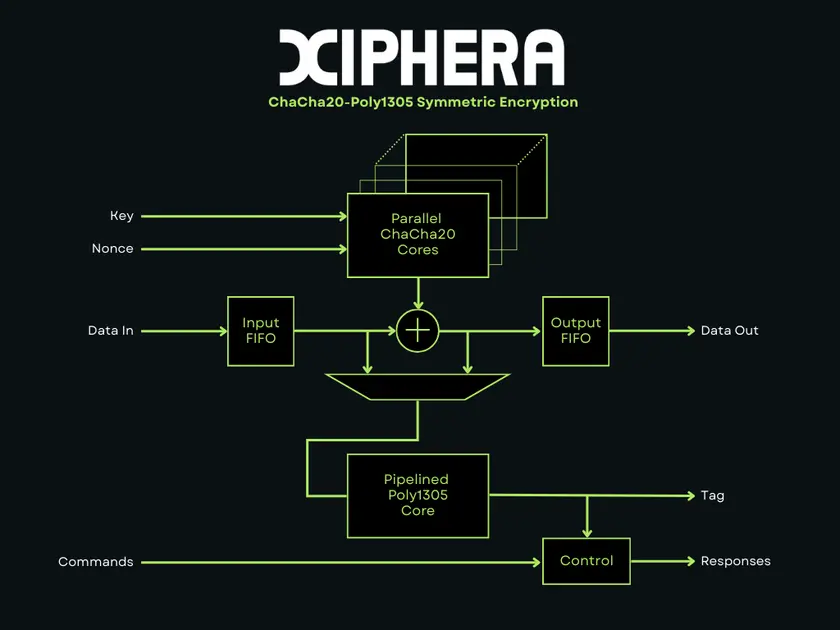
ChaCha20 is a modern encryption algorithm designed to protect data efficiently in real-world conditions. Unlike older standards that were built with specific hardware assumptions in mind, ChaCha20 was created to work fast and securely in pure software - on any device.
At its core, ChaCha20 is a stream cipher. Instead of encrypting data in fixed blocks, it generates a continuous stream of encrypted output that is combined with your data in real time. This approach fits naturally with how internet traffic works: constant, dynamic, and packet-based.
ChaCha20 uses a 256-bit key, which provides a very high level of cryptographic strength. In VPN and TLS implementations, it is typically paired with Poly1305, a message authentication algorithm that ensures data hasn’t been altered in transit. Together, they form a secure and efficient encryption system known as ChaCha20-Poly1305.
One of the defining features of ChaCha20 is predictability. Its performance doesn’t depend on special CPU instructions or hardware acceleration. Whether it’s running on a high-end laptop, a smartphone, or a low-power router, ChaCha20 behaves consistently - and that consistency is exactly what modern VPN connections need.
You don't really use ChaCha20; you just see the results: faster and smoother internet. Basically, it scrambles your data as it travels, but it doesn't slow things down much.
Older ways of encrypting data worked better on some devices than others. ChaCha20 doesn't have that issue. Your VPN should feel just as fast on your phone as it does on your computer. ChaCha20 helps with that.
It also works well even when your internet isn't great. If you're on a phone, using public Wi-Fi, or have a slow connection, this lighter, faster encryption can really help. It keeps things moving and your connection steady.
For companies that give you VPNs, this is cool because they don't have to pick between safety and speed. And for you, it just means your VPN works like it should.
AES has long been considered the industry standard for encryption, and for good reason. When paired with hardware acceleration (such as AES-NI), it can deliver excellent performance. On modern desktops and servers, AES remains a strong and widely trusted option.
However, not all devices benefit equally from that hardware support.
ChaCha20 takes a different approach. It’s optimized for software execution, which means it performs consistently even on devices without dedicated cryptographic acceleration. On smartphones, tablets, and embedded systems, this often results in more stable speeds and lower power consumption.
In practical terms, the difference isn’t about which algorithm is “more secure”; both are considered safe when implemented correctly. The real distinction lies in how they behave outside ideal lab conditions. ChaCha20 offers predictable performance across platforms, while AES can vary depending on the underlying hardware.
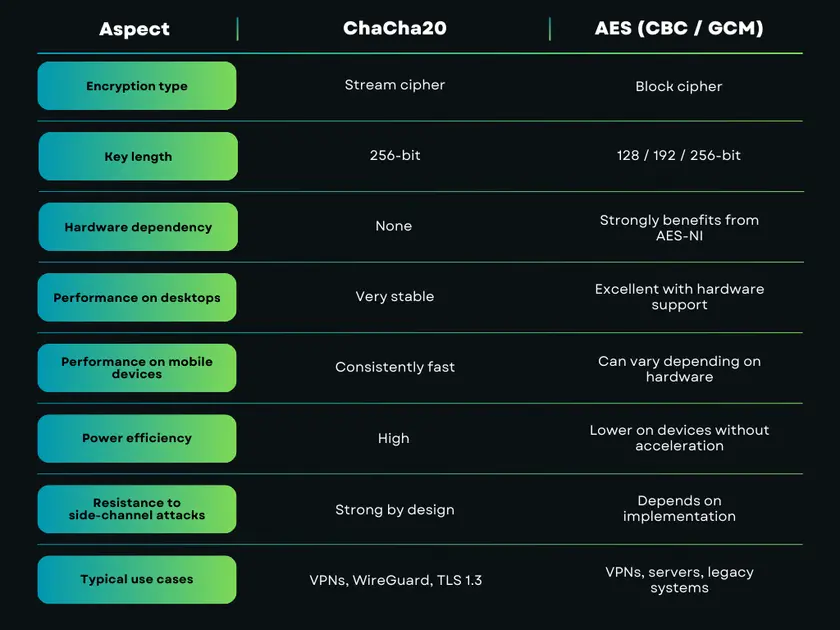
This comparison shows why ChaCha20 is getting more attention in today's VPN setups. AES is still a good, reliable option, but it works best when hardware helps it run faster - and not every device has that.
ChaCha20, though, works pretty much the same no matter what you're running it on. That consistency is often more useful for regular VPN use than getting top speed only when everything is just right.
Security is where ChaCha20 earns its reputation. The algorithm was designed by cryptographer Daniel J. Bernstein with simplicity and auditability in mind. Its structure avoids many of the complexities that have historically led to implementation flaws in older encryption schemes.
To date, there are no known practical attacks against ChaCha20 when it is used correctly. Its 256-bit key size provides a strong security margin, and its design reduces exposure to certain classes of side-channel attacks that can affect hardware-accelerated encryption.
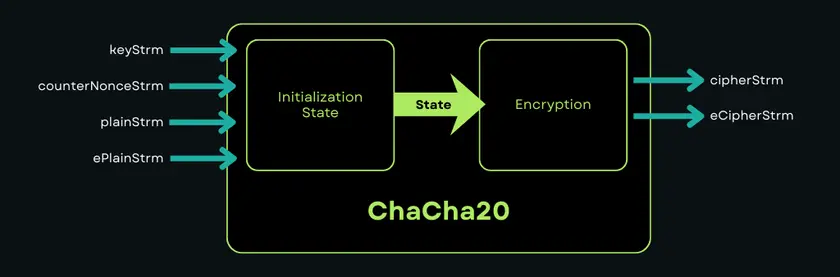
In practice, ChaCha20 is rarely used alone. In VPN and web security contexts, it’s paired with Poly1305 for authentication, ensuring that encrypted data cannot be silently modified in transit. This combination is widely reviewed, well documented, and trusted by the security community.
The algorithm’s adoption in modern standards like TLS 1.3 and WireGuard is a strong indicator of long-term confidence. These protocols were designed with current threat models in mind - and ChaCha20 was chosen deliberately, not as a fallback.
VPN traffic is constant, encrypted end-to-end, and often carried over imperfect networks. That makes efficiency just as important as cryptographic strength.
ChaCha20 performs especially well in scenarios where connections switch between networks, latency fluctuates, or bandwidth is limited. Mobile users moving between Wi-Fi and cellular networks benefit from encryption that adapts smoothly without sudden drops in performance.
Another practical advantage is consistency. With ChaCha20, users tend to get similar speeds regardless of the device they’re using. That predictability reduces the “why is my VPN slow on this device?” problem and leads to a more reliable overall experience.
For VPN providers, this means fewer compromises between security and usability. For users, it simply means the VPN does its job quietly in the background.
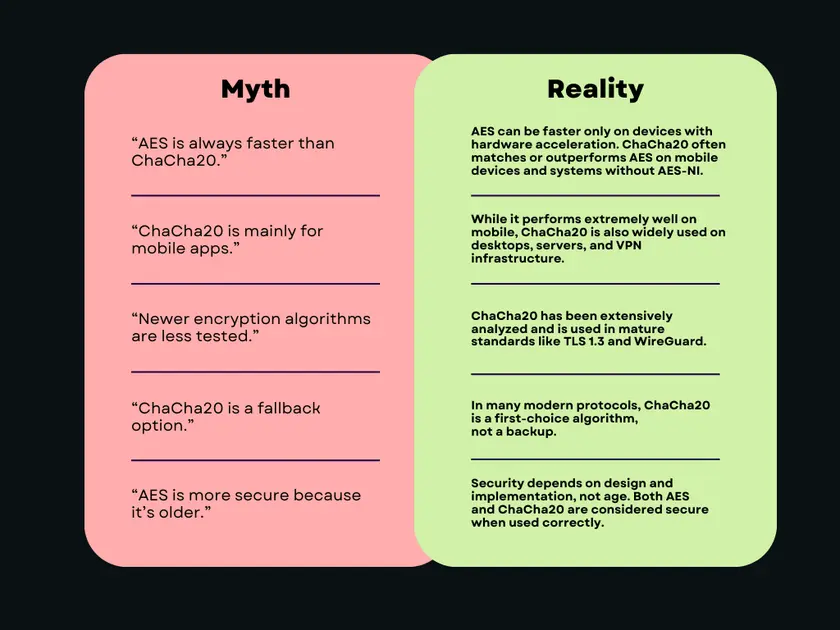
This contrast helps explain why ChaCha20 isn’t a niche or experimental option. Its growing adoption reflects a shift toward encryption that’s optimized for modern networks, devices, and usage patterns - not just legacy assumptions.
At Guru VPN, we pick encryption methods based on what works best in the real world, not just on paper. We want to keep your data safe without slowing you down. It doesn't matter if you're on a computer, using your phone on public Wi-Fi, or have a router covering all your gadgets.
ChaCha20 lets us give you strong, up-to-date encryption that runs smoothly no matter what device you're using. It doesn't need special hardware, so everyone gets the same security and speed.
We think about how people really use VPNs these days – in all sorts of places, on shaky networks, and with many different devices. Picking ChaCha20 isn't about chasing the latest fad; it's about building something that works well for everyone.
The internet's changed a lot, and encryption had to keep up. Old encryption methods still work, but today's VPNs have new problems: keeping connections steady on phones, making sure speeds stay good, and handling current security risks.
ChaCha20 is built for this new situation. It's secure but also fast and reliable on computers and phones. If you're using a VPN, this means your connection will be private and won't slow you down. For VPN companies, it's a solid way to build modern, secure systems that last.
That's why we at Guru VPN use ChaCha20 - it's a practical choice for keeping our users safe on today's internet. It's not just something we talk about; it's how we've built our system.